

Last Updated on April 14, 2026
Balancing Clinical Safety with “Home Comforts”: The Modern Care Home Bathroom
For Care Home Managers and Architects, the bathroom is the hardest room to design.
It must meet strict CQC (Care Quality Commission) standards for safety and infection control. It must withstand heavy daily usage by carers and hoists. Yet, it must not look like a hospital. It is, after all, the resident’s home.
At EA Mobility, we specialise in Care Sector Installations. We understand the unique pressures of the care environment.
Whether you are refurbishing a single en-suite or upgrading an entire wing, here is your guide to durability, compliance, and dignity.
1. The “CQC Compliant” Checklist
To meet 2026 regulations, your bathrooms must demonstrate safety and hygiene.
- Infection Control: Grout lines harbor bacteria. We recommend Thermoformed Wall Cladding (like Altro Whiterock) and heat-welded Safety Vinyl Flooring. These are impervious, wipe-clean, and meet the highest hygiene standards.
- Anti-Scald Safety: All brassware must be TMV3 Certified (not just TMV2) for high-risk environments, ensuring water never exceeds 41°C–43°C.
- Emergency Access: Doors must allow emergency access from the outside and should ideally open outwards or slide to prevent entrapment.
2. Equipment: Built for Heavy Use
Residential equipment often fails in a care home setting. You need commercial-grade durability.
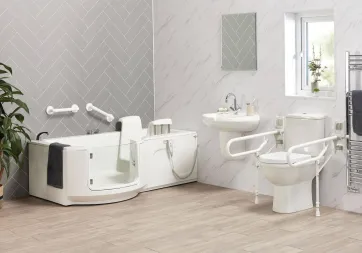
The Assisted Bath (Hi-Lo)
Staff back injury is a major operational risk.
- The Solution: Hi-Lo Power Baths. These baths lift the patient and the water.
- The Benefit: The bath rises to waist height, allowing the carer to wash the resident without bending, reducing musculoskeletal staff sickness.
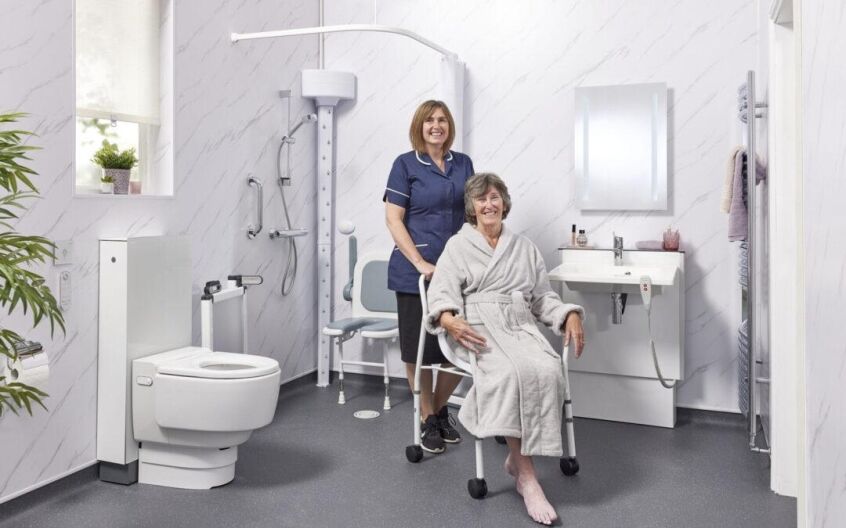
Ceiling Track Hoists (X-Y Systems)
Mobile hoists clutter corridors and damage door frames.
- The Solution: X-Y Ceiling Hoists covering the bed and bathroom.
- The Benefit: Seamless transfer from bed to bath/toilet with zero manual lifting. (See our Hoist Guide).
Thinking about a safer bathroom?
Book a free, no-obligation home visit. We assess the room, check whether you qualify for 0% VAT, and leave you a fixed-price quote to think about in your own time.
 Book a Free Home Assessment
Which? Trusted Trader · Lifetime installation guarantee · 0% VAT if you qualify
3. Dementia-Friendly Design Principles
If your facility caters to dementia patients, “White-on-White” is dangerous.
- Visual Contrast: Use a toilet seat (Blue/Red) that contrasts with the pan. Use grab rails that contrast with the wall. This helps residents identify fixtures and reduces falls.
- Familiarity: Avoid high-tech touchscreens. Use traditional-looking cross-head levers or simple push-buttons that residents recognise from their youth.
- Flooring: Avoid speckled flooring that looks like “holes” or “dirt” to a dementia patient. Use matte, solid colours.
4. Wet Rooms vs. Pods for Care Homes
Option A: The Care home Wet Room
- Pros: Maximises space for two carers. Fully accessible for shower trolleys.
- Cons: Longer installation time (downtime for the room).
Option B: Modular Shower Pods
- Pros: 100% Leak-Proof guarantee. Installed in 24 hours (minimising room vacancy). No grout to clean.
- Cons: Fixed sizes.
5. Project Management: Minimising Disruption
We know that an empty room costs you money.
- Speed: We work to strict deadlines to minimise “void periods.”
- Safety: All our installers are DBS Checked and trained to work in occupied care environments, respecting resident privacy and routine.
Frequently Asked Question
Q: Can you work on multiple rooms at once?
A: Yes. We have large teams capable of refurbishing multiple en-suites simultaneously to complete a wing renovation quickly.
Consultation
Don’t risk compliance with a residential builder. Choose a specialist.

Kian Carvell
Project Manager at EA Mobility
Kian plays a pivotal role in driving our family-owned company’s growth through strategic partnerships and innovative marketing. He is dedicated to a customer-first approach, ensuring excellence and satisfaction at every stage of the journey.