

Last Updated on September 15, 2026
The Myth of the “Hospital Bathroom”
When most people hear “disabled wet room ideas,” they picture white plastic chairs, exposed piping, and clinical blue flooring.
At EA Mobility, we believe your bathroom should be a sanctuary, not a reminder of limitations. Whether you are adapting a family home or designing a wheelchair-accessible ensuite, the goal is “Invisible Accessibility.” This means the safety features are there, but the style is what catches your eye.
Quick answer
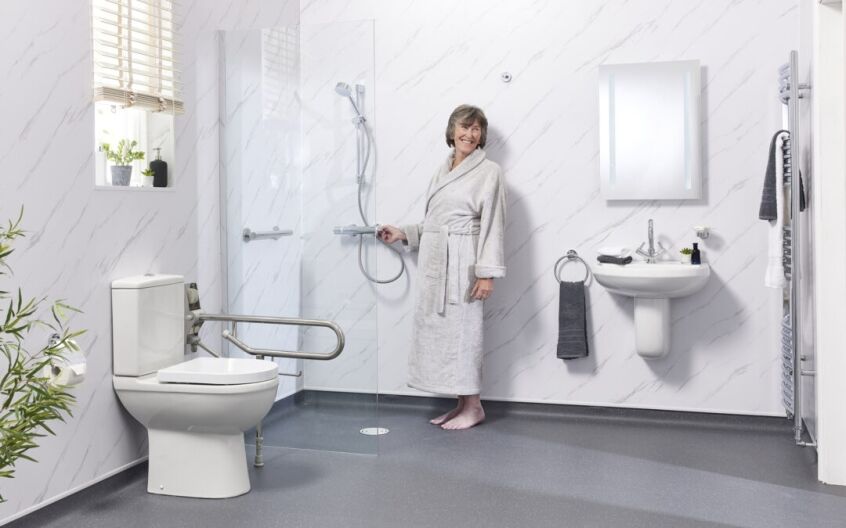
A disabled wet room is a fully waterproofed, level-access bathroom where the floor itself is graded to a drain, so there is no tray, step or enclosure to climb over. The best disabled wet room ideas combine R11-rated slip-resistant flooring, a zero-threshold entry, thermostatic showers, side-wall controls at seated height and grab rails in a finish that matches the taps—so the room reads as a designed bathroom, not a clinical one.
Key takeaways
- The five biggest UK design trends for accessible wet rooms in 2026 are spa-style, industrial high-contrast, smart technology, small-space layouts and luxury finishes.
- Wood-effect safety vinyl and textured porcelain give warmth and grip; both are available at R11 slip resistance.
- High-contrast schemes (dark grout, black rails, Crittall screens) help users with dementia or low vision navigate the space.
- Minimum practical footprint for a wheelchair wet room is about 1.5m × 2m; pocket doors and wall-hung fixtures reclaim floor space.
- Level-access wet rooms can be installed upstairs on timber floors using a structural former.
- If a low step is manageable, a tray-based walk-in shower is a simpler and usually cheaper alternative; see our walk-in shower cost guide.
- Most customers save 20% through VAT relief on qualifying work; council grants exist but typically take many months to process.
Last reviewed: 14 September 2026 by Denleigh Carvell, Project Manager at EA Mobility. EA Mobility has been a Which? Trusted Trader for 8 consecutive years and is a partner of Parkinson’s UK and the MS Society.
In this guide
The 5 Disabled Wet Room Styles at a Glance
| Style | Best suited to | Signature safety feature | Key materials |
|---|---|---|---|
| Spa style | Arthritis, stiff joints, anyone wanting a calming space | Warm R11 wood-effect vinyl and built-in tiled seating | Wood-effect vinyl, stone-texture porcelain, recessed niches |
| Industrial | Visual impairment, dementia | High-contrast black-on-white for spatial awareness | Crittall screens, matte black rails, dark grout |
| Smart technology | Limited dexterity, progressive conditions (MS, Parkinson’s) | Digital pre-set showers and motion-sensor lighting | Wash/dry smart toilet, body dryer |
| Small-space layout | Wheelchair users in compact UK bathrooms | Curbless entry and full turning circle | Pocket doors, wall-hung basins, fold-flat seats |
| Luxury | Homeowners future-proofing and adding property value | Underfloor heating that dries the floor fast | Marble-effect porcelain, brushed gold, linear drains |
Here are 25 innovative ideas to transform your bathroom, categorised by the latest UK design trends. If you’re ready to move from inspiration to installation, explore our full range of wet rooms for disabled and elderly homeowners.
Trend 1: Spa Style Disabled Wet Room Ideas (Natural & Warm)
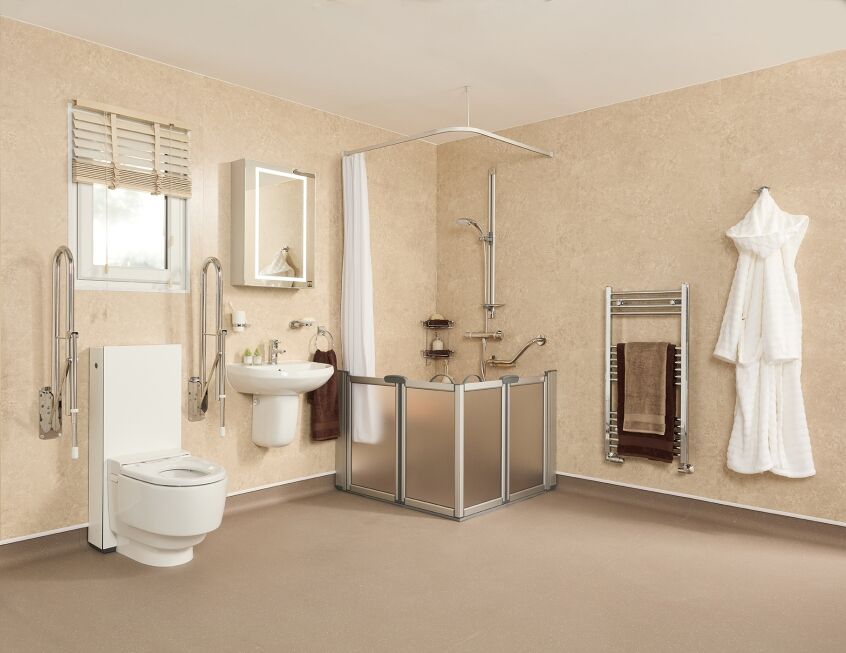
This is the #1 trend in UK bathrooms right now. It uses texture to create a calming space, perfect for relaxing stiff joints.
1. Wood-Effect Safety Vinyl:
Cold tiles can feel clinical (and slippery). Use high-quality anti-slip vinyl in a warm Oak or Walnut finish. It looks exactly like luxury timber decking but offers R11 slip resistance and is warm underfoot.
2. Stone-Texture Porcelain:
If you prefer tiles, choose textured porcelain that mimics river stone or slate. The texture provides excellent grip for crutches or walking frames while looking like a 5-star retreat.
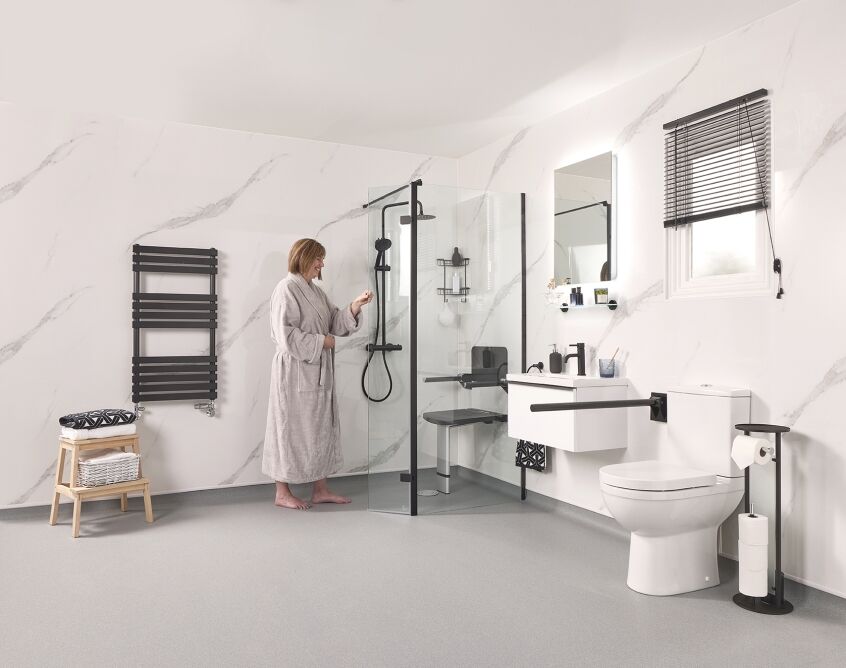
3. Built-In Tiled Seating:
Instead of a plastic fold-down chair, build a permanent bench seat tiled in the same stone as the walls. It looks like a steam room feature, is rock-solid, and easier to clean.
4. Recessed Shampoo Niches:
Protruding metal shelves are a hazard for falls. Recessed niches keep bottles flush within the wall and look ultra-modern. Add waterproof LED strips inside for a “floating” light effect.
5. Biophilic Design (Indoor Plants):
High-humidity plants (like ferns) placed on high shelves add life and oxygen to the room. This “connection to nature” is proven to boost mental well-being.
Thinking about a safer bathroom?
Book a free, no-obligation home visit. We assess the room, check whether you qualify for 0% VAT, and leave you a fixed-price quote to think about in your own time.
 Book a Free Home Assessment
Which? Trusted Trader · Lifetime installation guarantee · 0% VAT if you qualify
Trend 2: Industrial Style Accessible Wet Room Designs (Bold & High Contrast)
Perfect for those with visual impairments. The high contrast between black and white helps define the space clearly.
6. Crittall-Style Screens:
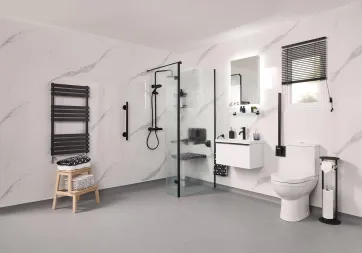
Shower screens with black grid frames are a massive trend. Functionally, the black frame makes the glass highly visible, preventing users with poor eyesight from bumping into invisible glass panels.
7. Matte Black Grab Rails:
Swap standard chrome for matte black safety rails. Against white tiles, they act as a striking architectural feature rather than a “medical aid.”
8. Subway Tiles with Dark Grout:
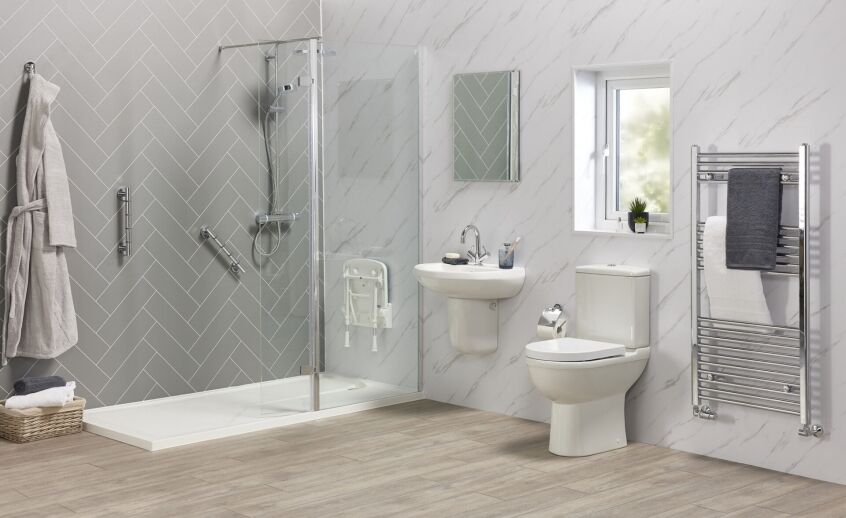
Classic white brick tiles with dark grey grout. The grout lines clearly define the walls, aiding spatial awareness for those with dementia or vision loss.
9. Exposed “Vintage” Piping:
Thermostatic mixer showers with exposed chrome or copper piping look stylishly vintage, but the controls are often easier to grip and turn than modern flush buttons.
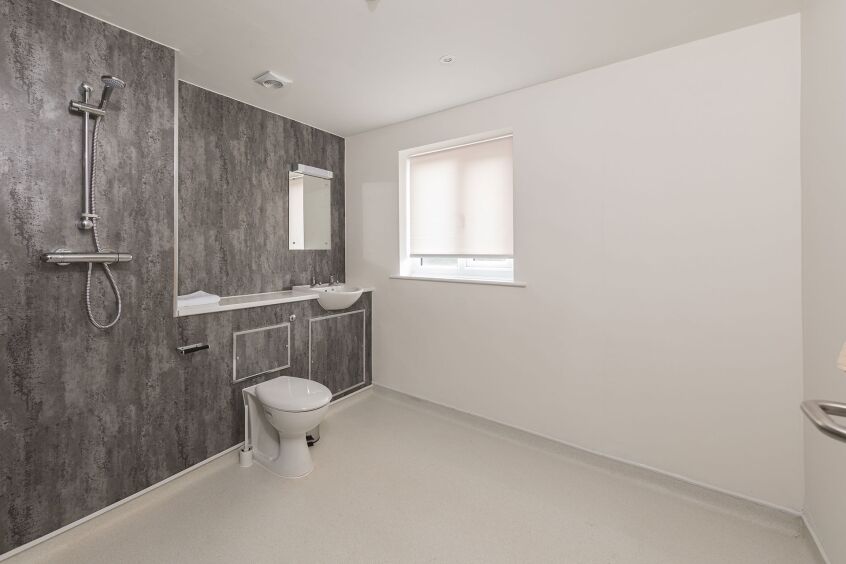
10. Concrete-Effect Walls:
Large format tiles that look like polished concrete. Fewer grout lines mean less cleaning (see our cleaning guide here) and a seamless, modern look.
Like what you see? Every one of these finishes can be built into a fully level-access design.
Trend 3: Smart Technology for Disabled Wet Rooms (Future-Proofing)
Technology that offers independence and ease of use.
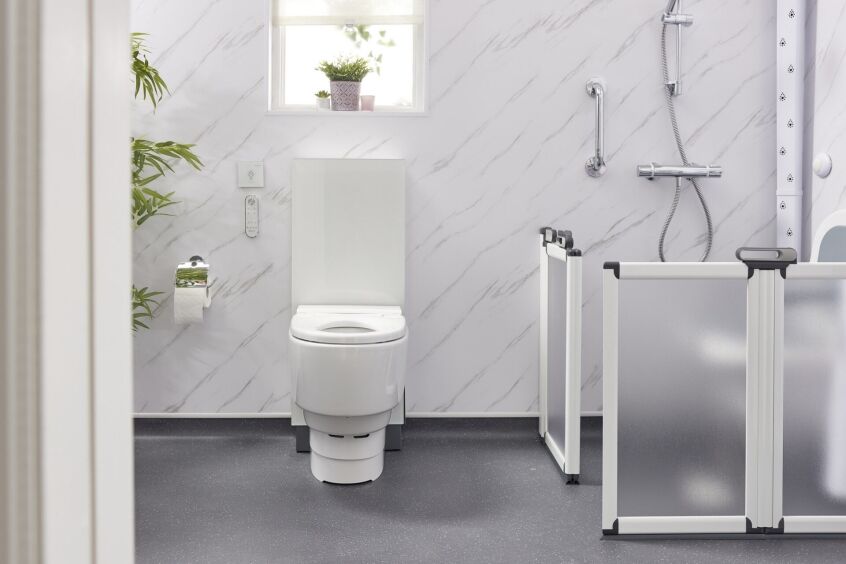
11. The Japanese Smart Toilet (Wash/Dry):
A toilet like the Geberit AquaClean washes and dries you automatically with warm water. It offers total independence for those with limited dexterity in a sleek, rimless design.
12. Digital Showers:
For users with arthritis, turning a stiff tap is painful. Digital showers let you start the water from a button by the door (or even your phone) so it’s the perfect temperature before you step in.
13. Motion Sensor Lighting:
Fumbling for a pull cord in the dark is a fall risk. Soft motion-sensor lights that fade on as you enter are essential for night-time safety.
14. The “Body Dryer”:
A warm air tower installed in the corner. Step out of the shower and get dried automatically without the slip-hazard of balancing on one leg to towel off.
Trend 4: Small Disabled Wet Room Layout Ideas
How to make a small British bathroom feel big.
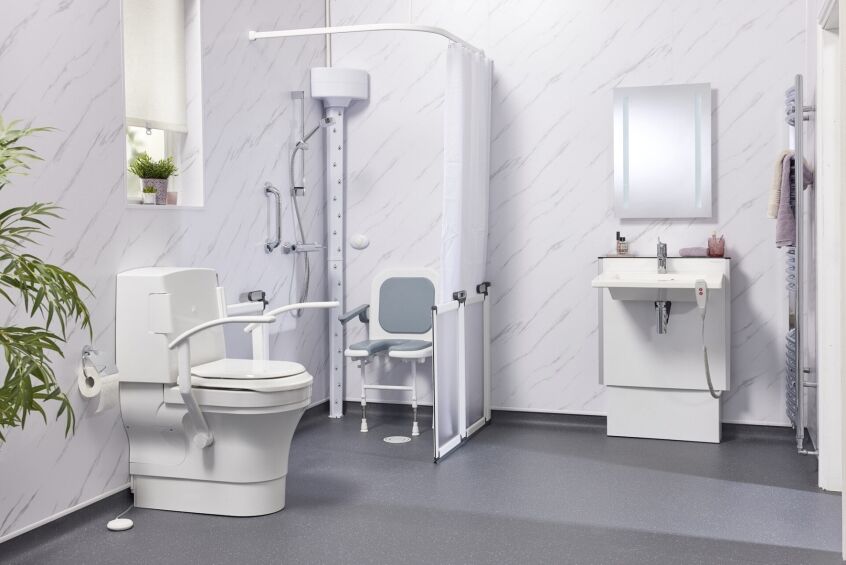
15. The Pocket Door:
Replace a swinging door (which eats up space) with one that slides into the wall. This reclaims 100% of your turning circle space for a wheelchair.
16. Wall-Hung Basins:
A “floating” sink looks modern, but functionally it leaves the floor clear for a wheelchair user to get their knees underneath comfortably to wash their hands.
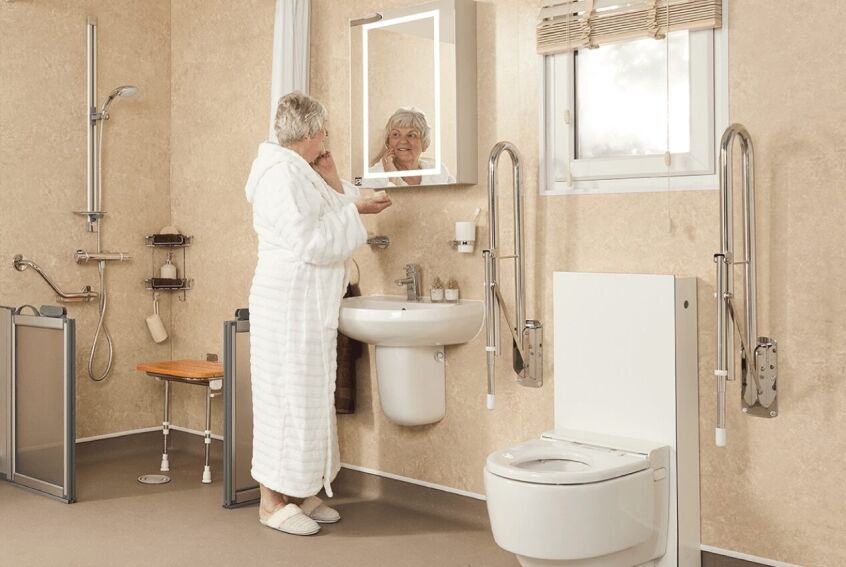
17. Fold-Flat Wooden Seats:
If you can’t build a tiled bench, install a modern wooden-slatted seat that folds completely flat against the wall. It’s there when you need it, invisible when you don’t.
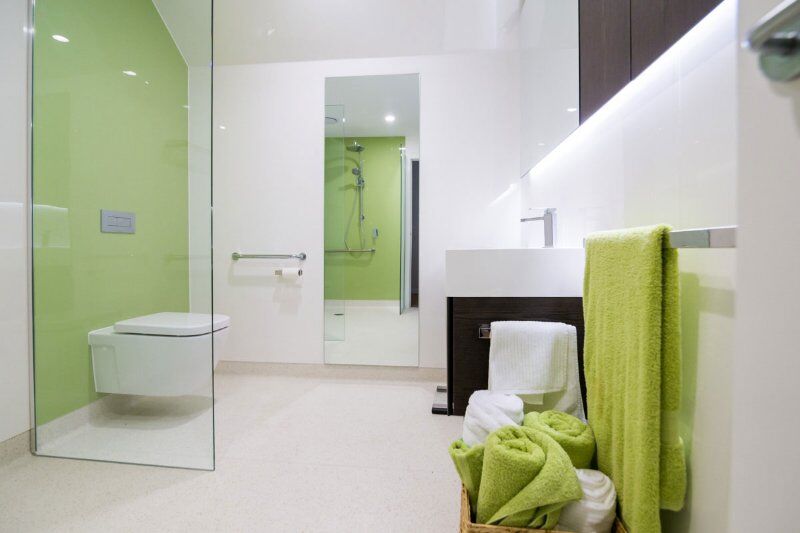
18. Curbless Entry:
A true wet room has zero steps. The floor flows from the door to the drain without interruption. This visual continuity makes small rooms feel 30% bigger.
Working with a compact bathroom? See how we fit level-access wet rooms into the smallest UK homes.
Trend 5: Luxury Disabled Wet Room Design Ideas
The details that add value to your property.
19. Underfloor Heating:
This is almost mandatory for a luxury wet room. It dries the floor rapidly (preventing damp) and removes the need for bulky radiators. (Concerned about running costs? Read our guide).
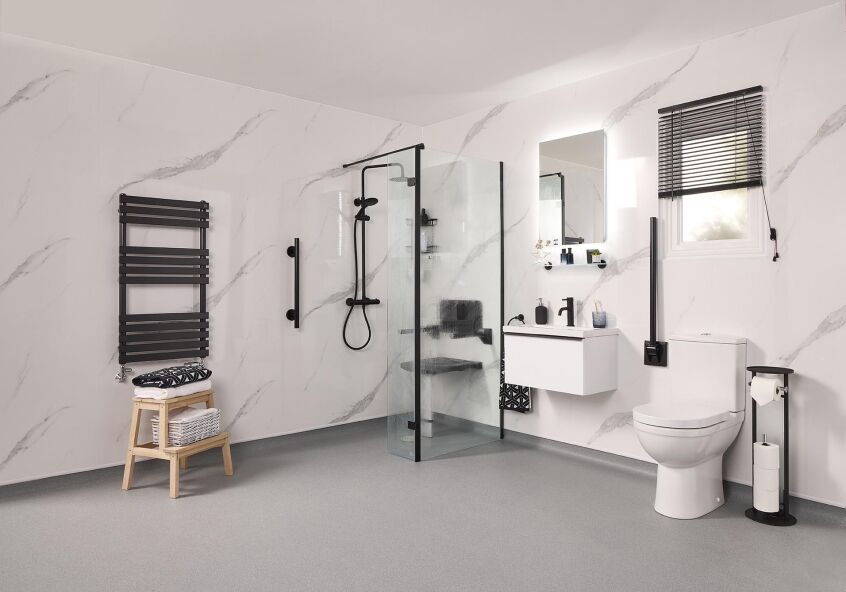
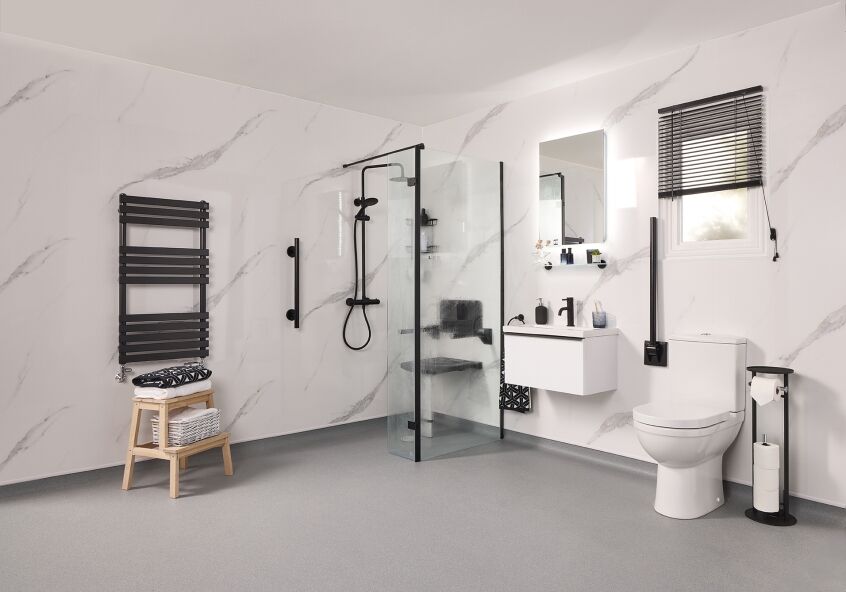
20. Marble-Effect Porcelain:
Get the opulent look of Carrara marble without the porous, slippery nature of real stone.
21. Brushed Gold Fixtures:
Gold or brass taps warm up the room visually and look incredibly high-end compared to standard chrome.
22. Linear “Hidden” Drains:
Instead of a central plug hole, use a linear drain. It can be tiled over so the water seems to disappear into a thin slot in the floor.
23. Acoustic Paneling:
Soft furnishings reduce echo, making the room quieter and calmer—a huge benefit for hearing aid users.
24. Vertical “Designer” Radiators:
If you need a radiator, choose a tall, vertical one in anthracite or colour-matched to your wall. It saves floor space and looks like art.
25. Level-Access Upstairs:
Yes, you can have these designs on the first floor! With the right structural former, wet rooms are safe upstairs. (Read more about upstairs installation here).
Can I get help with the cost of these designs?
Many people assume a stylish wet room means paying full price. It rarely does. If the wet room is being installed because of a long-term condition or disability, the work usually qualifies for 0% VAT, which takes 20% off the cost immediately and needs nothing more than a simple declaration. Attendance Allowance can also be put towards bathroom adaptations. A council Disabled Facilities Grant (DFG) exists too, but it is means-tested and the assessment and approval process commonly takes many months, so most of our customers use VAT relief and go ahead privately rather than wait.
- VAT exemption on disabled bathrooms: who qualifies
- Attendance Allowance 2026: rates and using it for bathing safely
- Who is entitled to a wet room? Funding routes compared
Frequently Asked Questions (FAQs)
Q: What is the minimum size for a disabled wet room in the UK?
A: Ideally, a wet room should be at least 1.5m x 1.5m to allow a wheelchair to turn comfortably. However, at EA Mobility, we specialise in small wet room designs and can often adapt smaller spaces using clever layouts like pocket doors and wall-hung fixtures.
Q: Do I need planning permission to install a wet room?
A: In most cases, no. converting an existing bathroom into a wet room is considered “Permitted Development.” You would only need planning permission if you are building a new extension to house it, or if you live in a Listed Building.
Q: How long does it take to install a disabled wet room?
A: A typical installation by our specialist team takes between 3 to 5 days. We handle everything from the plumbing and tanking to the tiling and electricals, minimising disruption to your home.
Q: Can I put a wet room on a timber floor (upstairs)?
A: Yes. This is a common myth. We use structural wet room formers that sit flush within your floor joists, strengthening the floor and creating the necessary gradient for drainage. It is completely watertight and safe for first-floor installations.
Q: Is a wet room suitable for dementia care?
A: Absolutely. We recommend specific design features for dementia-friendly wet rooms, such as high-contrast colours (e.g., blue floor, white walls) to define the space, matte surfaces to prevent glare, and traditional-looking fixtures to reduce confusion.
Q: Can a wet room be built for a wheelchair user in a small bathroom?
A: Yes — and this is where specialist installation matters most. The absolute minimum floor area for a wheelchair wet room is approximately 1.5 m × 2 m, though 1.8 m × 2.4 m is far more practical. Tight spaces require careful planning: the door must open outward or slide, not swing inward, because a standard inward-swinging door can trap a fallen user and block access for carers. A compact wall-hung toilet (with concealed cistern) and a fold-away basin can reclaim the floor clearance a wheelchair needs to turn. Every centimetre counts — a thorough pre-installation survey is essential before specifying anything.
Q: What is the best flooring for a disabled wet room, and what should you specifically avoid?
A: The gold standard for a disabled wet room floor is a porcelain or ceramic tile with a slip-resistance rating of R11 or higher (the R rating is the DIN 51130 standard used by occupational therapists and building control). An R11 surface provides meaningful grip even when the floor is heavily wet and soapy. Textured natural stone is visually striking but requires regular sealing and can become dangerously smooth when wet if not properly maintained. Avoid large-format tiles in small wet rooms where the grout lines that provide additional grip become too widely spaced. Never use standard household vinyl sheeting — it may be waterproof but offers insufficient slip resistance for a level-access shower environment.
Q: Does a disabled wet room need to meet specific building regulations in the UK?
A: Yes. Any structural wet room installation falls under Building Regulations Part P (electrical safety), Part M (accessibility), and the relevant sections of Part H (drainage). Part M sets minimum dimensions for accessible bathrooms including door clear opening width (775 mm minimum), turning circle space (1500 mm diameter), and fixture heights. If the installation is funded by a Disabled Facilities Grant, an occupational therapist assessment is required and the completed works must be signed off by building control. Even for private-funded installations, structural changes (such as altering drainage or removing walls) typically require building control notification. Skipping this step can affect buildings insurance and create complications on resale.
Q: What is the role of an occupational therapist in planning a disabled or accessible wet room?
A: An occupational therapist (OT) assessment is not a bureaucratic box to tick — it is the most practically useful input you can get before committing to a layout. An OT will assess the specific user: their current functional ability, what is likely to change over the next five to ten years, and what assistive equipment (hoist, shower chair, commode) needs to be accommodated. They will specify rail positions, seat type and height, valve type, and floor clearances based on that individual — not a generic template. Where a Disabled Facilities Grant is involved, an OT assessment is mandatory. For private-funded installations, involving an OT is still strongly recommended, especially where progressive conditions such as MS, Parkinson’s, or motor neurone disease mean that needs will change over time.
Turn These Ideas Into Reality
A wet room is an investment in your future independence. But looking at pictures is one thing—getting the technical design right is another.
At EA Mobility, we blend these stunning design concepts with the clinical requirements of OT assessments. We don’t just build “disabled bathrooms”—we build luxury suites that happen to be accessible.
Want to see how these ideas would look in your home?
Contact us today to book a Free Design & Home Assessment. We will bring material samples, colour charts, and our portfolio to you, so you can start planning your dream sanctuary.
Sources & Further Reading
- GOV.UK – Disabled Facilities Grants: eligibility and maximum award amounts.
- HMRC VAT Notice 701/7 – Reliefs from VAT for disabled and older people: the rules behind the 20% VAT saving.
- Approved Document M – Access to and use of buildings: door widths, turning circles and fixture heights.
- Approved Document P – Electrical safety: certification for wet room electrical work.
- Approved Document H – Drainage and waste disposal.
- HSE – Slips and trips: background on slip-resistance ratings for wet floors.
- EA Mobility & the MS Society and EA Mobility & Parkinson’s UK: our charity partnerships.

Denleigh Carvell
Project Manager at EA Mobility
Denleigh oversees projects across the UK—from walk-in baths and low-level showers to wet rooms—making homes safer and more accessible.