

Last Updated on October 28, 2026
Rediscover the Joy of Soaking: Is a Walk-In Bath Right for You?
For many of us, a shower is just a functional necessity. A bath is therapy. It is where we relax, soothe aching muscles, and warm up on a cold British evening.
But as we get older, the standard bathtub becomes the most dangerous item in the house. Stepping over a 500mm high rim requires balance and core strength that can decline with age or conditions like Arthritis.
The result? Many people stop bathing altogether, missing out on the pain-relief benefits of warm water.
At EA Mobility, we believe you shouldn’t have to give up your soak. The solution is simple: A Bath with a Door.
Whether you call it a “Walk-In Bath,” an “Easy Access Bath,” or a “Disabled Tub,” the principle is the same: Low entry, high safety.
This guide explains how a bath with a door works, the difference between inward and outward opening doors, and how to stay warm while it drains. To compare models, see our full range of walk-in baths.
How Does a Walk-In Bath Work?
It sounds obvious, but the mechanism is clever. Unlike a normal bath where you climb over the side, a walk-in bath has a watertight door integrated into the wall of the tub.
The 5-Step Process:
- Step In: The threshold is usually just 150–200mm (a tiny step compared to a normal bath).
- Close the Door: Using an easy-leverage handle.
- Fill: You fill the bath while you are sitting comfortably inside.
- Soak: Enjoy the hydrotherapy.
- Drain: You must wait for the water to drain before opening the door to get out.
- Pro Tip: This “waiting time” is the main difference. To combat this, we install Twin Waste systems that drain the water up to 50% faster than a standard bath.
The 3 Main Types of Walk-In Baths
One size does not fit all. We match the bath shape to your specific mobility level and bathroom size.
1. The Full-Length Walk-In Bath (The “Lie Down”)
- Best for: People who want a traditional reclining soak but can’t step over a high rim.
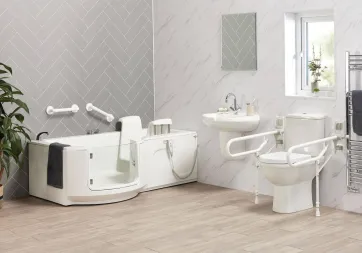
- What is it? These look similar to a standard bathtub (usually 1500mm to 1700mm long) but feature a watertight glass or composite door for low-level entry.
- The Benefit: It fits directly into your existing bath’s footprint, minimising the need for re-tiling or moving plumbing.
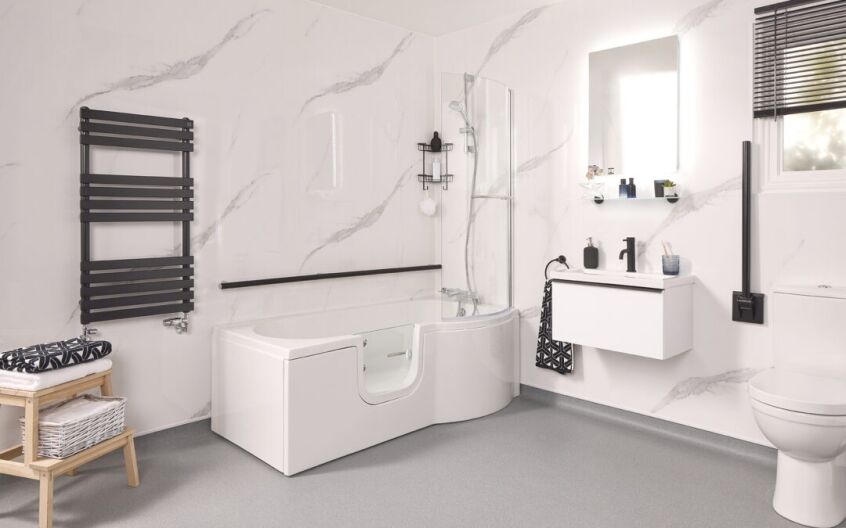
- The “P-Shape” Option: We also offer P-Shape Walk-In Shower Baths. These have a wider section at one end and a shower screen, giving you a spacious walk-in shower and a full-length bath in one unit. Perfect for multi-generational homes.
👉 Explore our range of Full-Length Baths
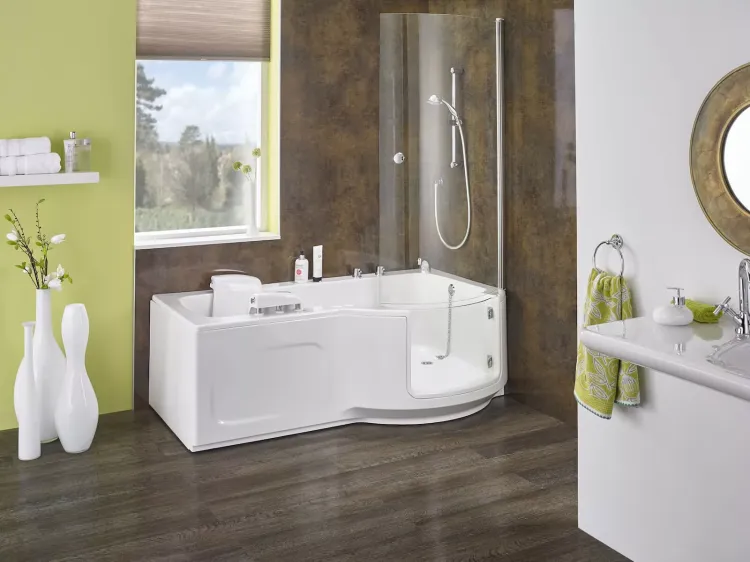
2. The Compact/Upright/Sit-In Bath (The “Deep Soak”)
- Best for: Small bathrooms or those who struggle to stand up from a low position.
- What is it? A shorter, taller tub (often 900–1200mm long). You enter and sit on a moulded, upright seat rather than lying flat on the floor.
- The Benefit: Often called a “Deep Soak” or “Sit-In Bath,” the upright position takes the pressure off your knees and hips. Because it is compact, it frees up massive amounts of floor space in smaller British bathrooms.
👉 View our Compact & Upright Bath options
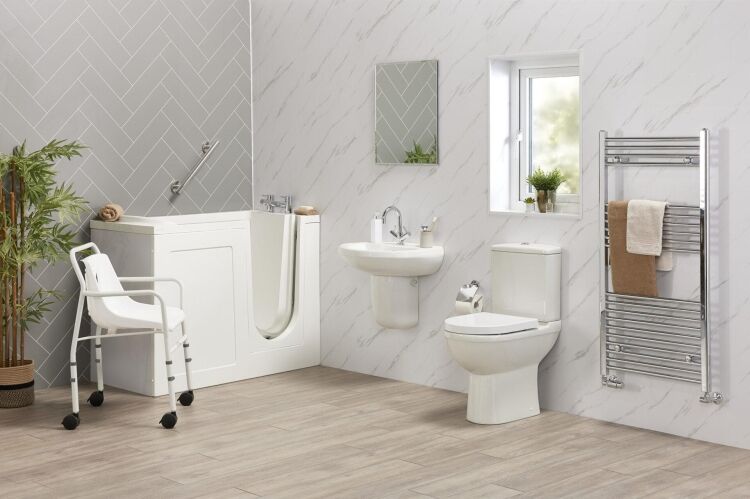
3. Baths with Powered Lifts (The “Assisted” Bath)
- Best for: Users with limited upper body strength who cannot raise themselves from a seated position.
- What is it? A full-length walk-in bath with an integrated Powered Belt Lift or rigid seat lift.
- How it works: You sit on the belt at a normal chair height. At the touch of a button, the lift gently lowers you right down to the bottom of the bath for a full soak, and lifts you back up again when you are finished.
- The Benefit: It offers the highest level of independence, removing the fear of getting “stuck” in the bath.
- 👉 See our Power-Lift Bath solutions
Finding the bath harder to get in and out of?
A walk-in bath or low-level bath gives you back a safe, comfortable soak. Book a free home visit: we measure the room, check whether you qualify for 0% VAT, and leave you a fixed-price quote to think about in your own time.
 Book a Free Home Visit
Which? Trusted Trader · Free home visits across the UK · Lifetime installation guarantee · 0% VAT if you qualify
Critical Choice: Inward vs. Outward Opening Doors
This is a technical detail most people miss, but it is vital for safety.
1. Inward Opening Doors
- How it works: The door opens into the bath.
- The Pro: As the bath fills, the water pressure pushes the door shut, creating a failsafe seal. It is great for small rooms as the door doesn’t swing out.
- The Con: You have to “shimmy” around the door to get in and close it.
2. Outward Opening Doors
- How it works: The door swings out into the room.
- The Pro: Much easier access. Essential for wheelchair transfers, as you can slide directly from a chair onto the bath seat without the door getting in the way.
- The Con: Requires a special latch mechanism to ensure it stays watertight.
Who Needs a Walk-In Bath? (The Health Benefits)
1. Arthritis & Joint Pain (Hydrotherapy)
Warm water therapy reduces inflammation and stiffness in joints. A walk-in bath allows you to soak safely, easing the morning stiffness associated with Rheumatoid Arthritis or Osteoarthritis.
2. Poor Circulation & Edema
For those with swollen legs or feet, soaking in warm water can improve circulation. The “Upright” baths are excellent for this as they allow a deep soak without lying flat (which can cause breathing issues for some).
3. Independence (No Carers)
Needing help to get in the bath feels vulnerable. A walk-in bath restores your privacy. You are in control.
The “Elephant in the Room”: Staying Warm
We value honesty. The drawback of a bath with a door is that you are sitting inside while it fills and drains.
How we keep you warm:
- Twin Wastes: Two plugs are better than one. This drains the water in minutes.
- Thermostatic Mixers: High-flow taps that fill the bath quickly with perfectly regulated temperature (preventing scalds).
- Heated Seats: Many of our luxury upright models come with heated seats and backrests, so you stay cosy even before the water rises.
- Bathroom Temperature: We recommend installing a high-output towel rail or heater to keep the air temperature warm while you wait.
Are Walk-In Baths Worth It?
In short: a walk-in bath is worth it if bathing matters to you, for comfort, routine or relief from joint and muscle pain, and you can manage a low step and sit while the bath fills and empties. If you mainly want to get clean safely, or you use a wheelchair, a walk-in or level access shower is usually the better choice.
Pros and cons
| Pros | Cons |
|---|---|
| A watertight door replaces the high bath side, with a low step of usually 150–200mm | You still step over a low threshold, so it is not suitable for wheelchair users without a powered seat |
| A built-in seat at chair height, so you sit down and stand up rather than lower yourself to the floor of the bath | You get in before it fills and wait for it to drain before you get out |
| Warm, deep water can ease stiff joints and muscles; spa and air jets are an option | Fill and drain time depends on your water pressure and hot water supply |
| Usually fits the space of an existing bath and is fitted in 1 to 4 working days | Takes up more room than a shower in a very small bathroom |
| Powered lift models lower and raise you for extra help | Used by one person at a time, so a shared family bath needs thought |
Who a walk-in bath suits
- People who love a bath and would miss it if it went.
- People with arthritis or muscle pain who find a warm soak helps. See hydrotherapy at home.
- People who tire standing and would rather wash sitting in water than on a shower seat.
Who should choose a shower instead
- Wheelchair users, or anyone who can’t lift their legs over a low step.
- People who want to wash quickly without waiting for the bath to fill and drain.
- Anyone whose needs are likely to change soon. A level access shower or wet room adapts more easily.
Still deciding? Compare the two side by side in walk-in bath vs walk-in shower, see how the common complaints are solved in 7 walk-in bath problems and solutions, or read walk-in bath vs bath lift.
How Much Does a Walk-In Bath Cost? (2026)
Prices vary depending on the features (Spa jets, Lights, Lifts).
- Standard Walk-In Bath: £6,000–£7,500+ (Supply & Fit).
- Luxury / Power-Lift Bath: £9,000–£12,000+.
- Note: If you have a chronic condition, you are eligible for VAT Exemption, saving 20% on these prices. Read our full 2026 Cost Breakdown here.
A note on the prices in this guide
The figures on this page are typical ranges to help you plan, not quotes. Every accessible bathroom we fit is designed around the person using it, so once our surveyor has visited and understood what you need, the price of your bespoke solution can be quite different from the ranges shown here. The home survey is free, and the quote you receive afterwards is a fixed price.
Frequently Asked Questions
Q: Are walk-in baths worth it?
A: Yes, for people who want to keep bathing and can manage a low step of around 150–200mm and the wait while the bath fills and drains. For people who mainly want to wash safely, or who use a wheelchair, a walk-in or level access shower is usually better value.
Q: What are the disadvantages of a walk-in bath?
A: You sit inside while it fills and drains, there is still a low step at the door, and it is not suitable for wheelchair users without a powered seat. Fill and drain times depend on your water pressure and hot water supply.
Q: How long does a walk-in bath take to fit?
A: Usually 1 to 4 working days when it goes into the space of the existing bath. Powered-lift models, floor repairs or a long waste run take it towards the longer end.
Q: Are the handles hard to use?
A: No. We use Arthritis-Friendly levers that require very little grip strength to lock and unlock. They are designed for weak hands.
Q: Can I replace my existing bath?
A: Yes. Most full-length walk-in baths are designed to fit the standard UK 1700mm x 700mm footprint. This minimizes the need for re-tiling or moving plumbing.
Q: Do you offer spa options?
A: Yes. We can fit Air Spa (gentle bubbles) or Hydro Spa (water jets) systems. These are fantastic for massaging aching muscles.
Ready to Soak Safely?
Don’t let mobility issues stop you from enjoying a relaxing bath. Whether you need a compact upright tub or a full-length luxury spa bath, we have a solution.
Our team will measure your bathroom and recommend the perfect tub shape and door type for your needs.

Denleigh Carvell
Project Manager at EA Mobility
Denleigh oversees projects across the UK, from walk-in baths and low-level showers to wet rooms, making homes safer and more accessible.
Free · No obligation · UK-wide
Ready for a safer, easier bathroom?
Tell us a little about your bathroom and one of our own surveyors will visit at a time that suits you, anywhere in the UK. You'll get honest advice and a fixed-price quote to consider in your own time.
- Rated 4.9 by Which? Trusted Traders
- Our own installers, never subcontracted
- 0% VAT on eligible installations
- Lifetime installation guarantee
Prefer to talk? Call free on 0800 955 8810