

Last Updated on September 24, 2026
A professionally installed walk-in shower in the UK costs £5,000 to £10,500 in 2026 for a full supply-and-fit job, including removing the bath, plumbing and electrical work, waterproofing, wall finishes and the safety features that make it usable. A basic low-level tray conversion sits at the bottom of that range; a level-access shower on a concrete floor with a pumped waste sits at the top. A fully tanked wet room is a separate project at £6,000 to £14,000.
Those are the prices we quote across the UK for accessible installations, and this guide explains exactly what moves a job from one end of the range to the other, so you can read any quote, including ours, with confidence.
Walk-in shower installation cost at a glance (2026)
| Type of walk-in shower | Typical installed cost | Best for |
|---|---|---|
| Low-level tray (shallow step, replaces the bath) | £5,000–£7,500 | Reduced balance or strength; safer access on a sensible budget |
| Level-access shower (flush with the floor) | £6,500–£9,500+ | Walking frames, shower chairs, wheelchair users, carer-assisted showering |
| Mobility wet room (whole room tanked) | £6,000–£14,000+ | Maximum turning space, full wheelchair access, carer room to work |
Prices are supply and fit, before VAT relief. If the shower is being installed because of a long-term condition or disability, most customers pay 0% VAT on the work (explained below), which takes a further 20% off.
Why prices online are so confusing
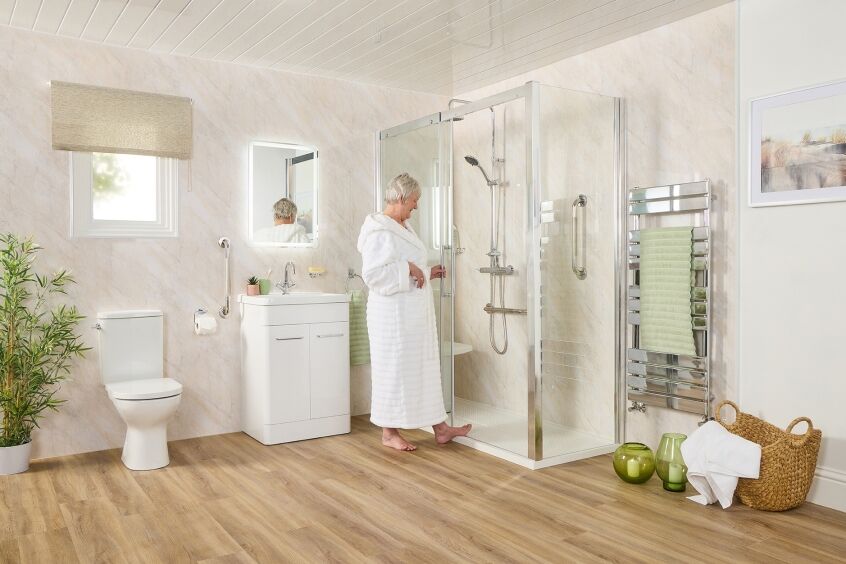
Search for walk-in shower prices and you’ll see “shower trays from £150”, “walk-in showers from £2,000” and specialist installations at £6,000 to £12,000. They are not the same thing. The £150 figure is a tray on its own. The £2,000 figure is usually a tray, a screen and a valve, fitted into an existing cubicle with no other changes. Neither includes removing a bath, fixing the floor underneath it, moving pipework, upgrading the electrics for an electric shower, waterproofing a level-access zone, safety flooring, seating and rails, or labour, disposal and a warranty. A true accessible walk-in shower is a small building project in a wet zone, which is why the honest range starts at around £5,000.
Want a fixed price for your bathroom?
Online calculators can't see your floor, drainage or electrics. Our surveyor can. Book a free home visit, anywhere in the UK, and get a fixed-price quote that doesn't change once work starts.
 Get a Free Fixed-Price Quote
Which? Trusted Trader · Free home visits across the UK · Lifetime installation guarantee · 0% VAT if you qualify
What a supply-and-fit quote should include
| Stage | What it covers | Why it affects the price |
|---|---|---|
| Survey and design | Water pressure and flow, boiler type, waste gradient, floor construction, electrical capacity, signs of previous leaks | A proper survey is what stops “hidden extras” appearing halfway through the job |
| Strip-out and preparation | Isolating water, removing the bath and finishes, disposal, exposing the subfloor and walls | Rot, mould or failed plasterboard found here has to be fixed before anything goes back in |
| Plumbing | Repositioning hot and cold feeds, thermostatic valve, relocating the waste, replacing old pipework | Keeping the shower over the existing bath waste is the single biggest saving |
| Drainage | Gravity waste, or a pumped waste where there is no fall to the soil stack | The biggest single swing factor between two quotes (see below) |
| Waterproofing | Sealing the tray zone, or full tanking for level access and wet rooms | Most bathroom failures are waterproofing failures; this is not the place to save money |
| Electrics (electric showers) | Dedicated cable, consumer unit rating, RCD protection, zoning | An electric shower can need a new cable run and a consumer unit upgrade |
| Wall finishes | Tiles or waterproof wall panels | Panels are quicker to fit and have no grout to maintain |
| Accessibility features | Grab rails, a rated seat, non-slip flooring, half-height screens, thermostatic controls | The difference between a shower and a safer bathroom |
The six things that change the price
1. Gravity or pumped waste
If the waste pipe can run downhill to the soil stack, the shower drains by gravity: simpler, cheaper and lower maintenance. If the shower is on a concrete floor, a long way from the stack, or there isn’t enough fall, it needs a pumped waste. A pump adds from a few hundred pounds to over a thousand depending on the routing, but it is also what makes level access possible in many ground-floor bathrooms.
2. Timber or concrete floor
Upstairs bathrooms on timber joists are usually the easier job: pipework is accessible, the waste can be re-routed, and a level-access former can be recessed between the joists. Concrete ground floors can’t be lifted, so drainage and floor forming become more technical and the job moves up a price band. This is the reason two identical-looking bathrooms can be quoted £2,000 apart.
3. Low-level tray, level access or wet room
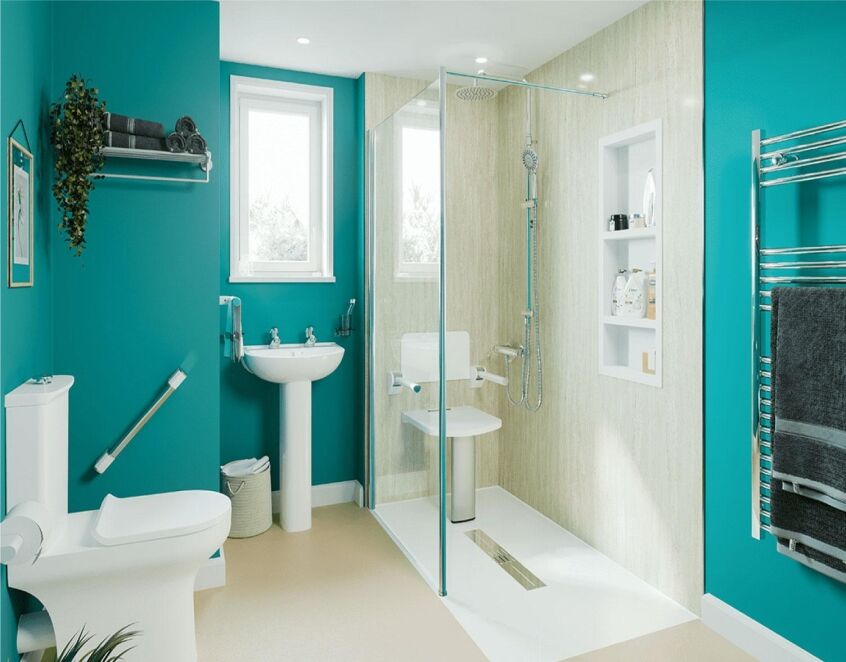
A low-level tray keeps most of the existing drainage and floor, so it is the cheapest safe conversion. True level access means forming falls in the floor and waterproofing the edges, which adds labour. A wet room tanks the whole floor and lower walls and is usually £1,500 to £2,000 more than a tray-based shower at the same finish level. Our guides to low-level access showers and level access showers explain the difference in detail.
4. Electric or mixer shower
A mixer shower runs off the boiler and is usually simpler to install where the pipework is accessible. An electric shower heats water as it flows and needs its own heavy-duty cable and often a consumer unit upgrade, which can add several hundred pounds. Electric showers are a useful back-up if the boiler fails, but they typically cost more per shower to run than a mixer on gas heating.
5. Tiles or wall panels
Tiling is labour-intensive and grout is the weak point over ten years: it discolours, cracks and lets moisture in. Waterproof wall panels fit in a fraction of the time, can often go over existing surfaces, have no grout lines and are easier to keep clean. For most accessible installations, panels give the lowest lifetime cost.
6. How much of the room changes
Moving the toilet or basin, widening the door, fitting a pocket door or moving a radiator each add labour. The cheapest safe project keeps the fittings where they are and puts the shower in the bath’s footprint. Our guide to walk-in shower layouts for small bathrooms shows what fits without moving anything.
Bath to walk-in shower conversion cost
Replacing a bath with a walk-in shower is the most common job we do, and because a standard 1700mm bath alcove takes a 1700mm x 700mm tray without moving the waste, it is also the most predictable. A straightforward conversion, with the bath removed, a low-level or level-access tray fitted in the same footprint, wall panels, a thermostatic valve and a glass screen, typically costs £5,000 to £8,500. Add £1,500 to £4,000 if the drain has to move, the floor needs structural work, or the room is being fully tanked as a wet room.
Running costs: what a walk-in shower costs to use
An electric shower’s running cost depends on its kW rating and your electricity tariff; a mixer shower’s depends on your gas rate and boiler efficiency. With gas cheaper per unit than electricity, a mixer is usually cheaper to run for someone who showers daily, and over ten to fifteen years the difference is meaningful. Underfloor heating in the shower zone adds a small running cost but dries the floor quickly, which matters more for safety than the pence involved.
VAT relief: the 20% most customers save
If the walk-in shower is being installed because of a long-term condition or disability, the supply and installation can be zero-rated for VAT under HMRC VAT Notice 701/7. You don’t need to be registered disabled or receive any benefit; arthritis, heart conditions, Parkinson’s, MS, dementia and significant balance problems all commonly qualify. On a £7,000 job that is £1,400 saved, handled by signing a short declaration at the point of order rather than claiming anything back. Our VAT exemption guide covers who qualifies and what is included.
Grants and other funding
A council Disabled Facilities Grant can fund an accessible shower for people with a permanent disability and low income and savings, but it is means-tested and the assessment and approval process commonly takes many months, so most of our customers use VAT relief and go ahead privately. Attendance Allowance and PIP are not means-tested and can be put towards the work. Our guide to who is entitled to a wet room compares the routes.
How to compare walk-in shower quotes
- Ask whether the price is supply and fit. A product price with “installation extra” is not comparable to a fixed-price installation.
- Ask for the exclusions in writing. Replastering, moving a radiator, a new door, decoration and disposal are the usual items left out of cheap quotes.
- Check the drainage assumption. A quote that hasn’t checked whether gravity waste is possible will change once the floor comes up.
- Check the valve. A thermostatic valve that holds temperature is essential for older users; a basic manual mixer is not.
- Check the guarantee. Waterproofing is where cheap installs fail. Our installations carry a lifetime installation guarantee.
- Ask whether the price already reflects VAT relief, and whether the installer handles the declaration for you.
Frequently asked questions
How much does a walk-in shower cost in the UK in 2026?
A professionally installed walk-in shower costs £5,000 to £10,500 supply and fit. Low-level tray conversions sit at £5,000 to £7,500, level-access showers at £6,500 to £9,500 and up, and fully tanked wet rooms at £6,000 to £14,000 and up. Eligible customers pay 0% VAT on top of those figures.
How much does it cost to replace a bath with a walk-in shower?
Typically £5,000 to £8,500 when the tray goes in the bath’s footprint and the waste stays where it is. Moving the drain, structural floor work or a full wet room conversion adds £1,500 to £4,000.
What is the cheapest way to install a walk-in shower?
A low-level tray in the existing bath position, gravity waste, wall panels instead of tiles, a mixer shower rather than a new electric circuit, and no changes to the toilet, basin or door. That combination keeps most jobs at the bottom of the range without cutting anything that matters for safety.
Is a walk-in shower cheaper than a wet room?
Yes, usually by £1,500 to £2,000 at the same finish level, because a wet room needs the whole floor tanked and formed to fall towards the drain. Our wet room cost guide covers wet room prices in detail.
Do I need a pumped waste?
Only if gravity drainage isn’t possible, which is common on concrete ground floors and where the shower is a long way from the soil stack. It adds cost but is often what makes level access achievable.
Can I get VAT relief on a walk-in shower?
If the installation is because of a long-term condition or disability, yes. The work is zero-rated under HMRC VAT Notice 701/7 once you sign an eligibility declaration; there is no application or waiting.
How long does installation take?
Most bath-to-shower conversions take three to seven days. Level-access showers on concrete floors and wet room conversions take longer because of the drainage and floor work.
Does a walk-in shower add value to a home?
It widens buyer appeal, particularly for older buyers, and removes a common objection in a small bathroom. A modern, well-finished walk-in shower rarely reduces value; a cramped, unusable bath sometimes does.
Get a fixed-price quote for your bathroom
Online calculators can’t see your floor type, your drainage fall, your electrics or hidden water damage, which is why they are so often wrong. We survey the bathroom, confirm whether you qualify for VAT relief, and give you a fixed-price quote that doesn’t change once the work starts.
Or call us free on 0800 955 8810 to talk through your bathroom.

Kian Carvell
Sales & Marketing Director at EA Mobility
With a diverse background encompassing business development, marketing, and strategic partnership management, Kian plays a key role in his family-owned company’s growth.
Free · No obligation · UK-wide
Ready for a fixed price, not an estimate?
Tell us a little about your bathroom and one of our own surveyors will visit at a time that suits you, anywhere in the UK. You'll get honest advice and a fixed-price quote to consider in your own time.
- Rated 4.9 by Which? Trusted Traders
- Our own installers, never subcontracted
- 0% VAT on eligible installations
- Lifetime installation guarantee
Prefer to talk? Call free on 0800 955 8810