

Last Updated on October 13, 2026
The “Carer’s Dilemma”: How to Assist Without Getting Soaked
If you care for an elderly parent or partner, you know the struggle. You are trying to help them wash in a standard shower cubicle. You have to lean over a high tray, reach around a fixed glass screen, or squeeze through a narrow door.
The result? You hurt your back, the floor gets slippery, and, worst of all, you end up with soggy socks and wet clothes.
Standard shower enclosures are designed for privacy, not care.
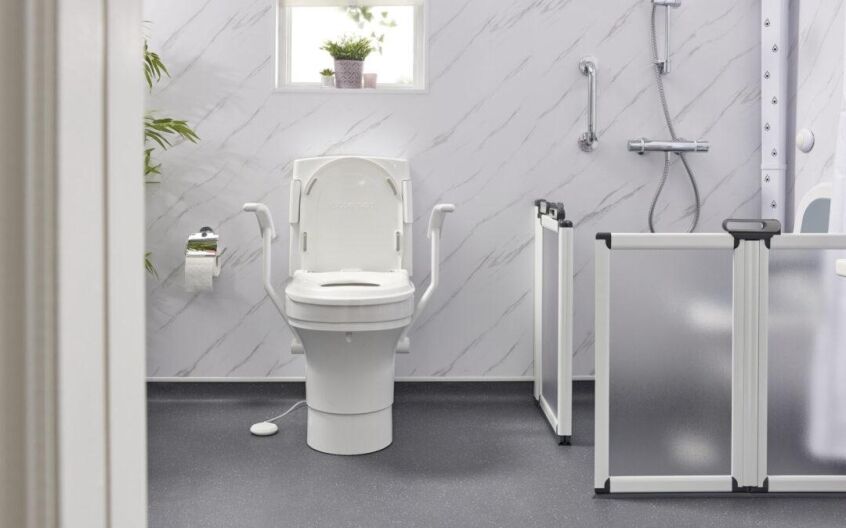
At EA Mobility, we install specialist Accessible Enclosures. The secret is in the engineering. By switching to Half-Height or Rising Bi-Fold doors, we transform the shower experience from a struggle into a safe, dry routine.
Here is your guide to the different types of doors and cubicles available in 2026.
1. The Half-Height Door (The “Stable Door” Solution)
- Replaces: [Stable Door Shower Enclosures]
This is the gold standard for assisted bathing.
What is it? A shower door that is split horizontally. It stands approx 750–900mm high (waist height).
- How it works: You close the doors to create a watertight seal at the bottom, keeping the water inside the tray. The top half remains open.
- Why it works: A carer can reach over the door to wash the user’s hair or back comfortably, whilst staying completely dry behind the shield.
- Privacy: When the carer isn’t there, you can pull a shower curtain across the top for full privacy.
2. Bi-Fold Doors (The 360° Space Saver)
- Replaces: [Compact and Convenient Bi-Fold Enclosures]
In small UK bathrooms, a door swinging out can hit the toilet or block a wheelchair.
What is it? Doors that fold in on themselves (concertina style).
- The “Rising Hinge” Secret: Our bi-fold doors feature “Lift & Lower” hinges. As you open the door, it lifts slightly (5mm) to clear the floor seal. When you close it, it drops down to lock the water in.
- The Benefit: They can swing 180 degrees. When you aren’t using the shower, you can fold them flat back against the wall, opening up the entire room for a wheelchair turning circle.
Planning a walk-in shower or wet room?
Our surveyors design and fit accessible bathrooms across the UK. Book a free home visit: we plan the layout with you, check whether you qualify for 0% VAT, and give you a fixed-price quote with no obligation.
 Book a Free Design Visit
Which? Trusted Trader · Free home visits across the UK · Lifetime installation guarantee · 0% VAT if you qualify
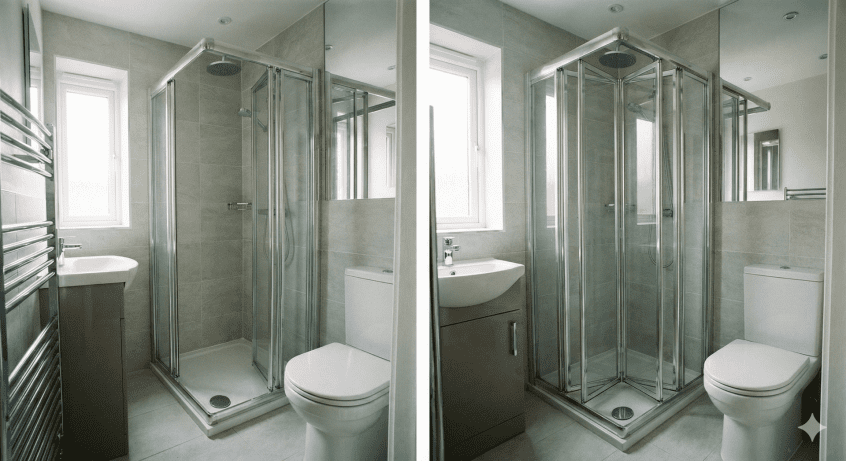
3. Corner Entry Cubicles (For Tight Spaces)
If you have a square shower tray in the corner of the room, a standard pivot door is awkward.
The Solution: An Accessible Corner Entry Cubicle.
- How it works: You have two sets of bi-fold doors (one on each side of the corner). They both fold back against the wall.
- The Benefit: This gives you the widest possible entry point. A wheelchair can roll straight into the corner without squeezing through a narrow gap.
4. Safety Glazing: Glass vs. Polycarbonate
This is a vital safety choice (YMYL).
Option A: Toughened Safety Glass (6mm)
- Pros: Looks like a luxury hotel shower. Treated with “Clean-Coat” to repel limescale.
- Cons: Heavy. If a frail user falls against it, it is strong, but hard.
Option B: Polycarbonate (PET)
- Pros: Virtually unbreakable and shatterproof. Extremely lightweight (easy for arthritic hands to open).
- Cons: Can scratch over time. Looks slightly more “clinical.”
Our Verdict: For most homes, Toughened Glass is best for resale value. For users with severe frailty or a high risk of falling, Polycarbonate offers the highest impact safety.
5. The “Shower Pod” (The All-In-One Cubicle)
If you don’t want to re-tile your bathroom, a Shower Pod is the answer.
What is it? A complete, self-contained unit (walls, floor, and doors) that slots into the corner.
- Pros: 100% Leak Free. No silicone to rot. No grout to scrub. Installed in 1 day.
- Cons: Fixed sizes. You can’t customise it to an awkward shaped wall.
Comparison: Which Door Do You Need?
| Door Type | Best For… | Carer Access | Space Saving |
| Half-Height | Assisted Bathing (Carers) | ⭐⭐⭐⭐⭐ | ⭐⭐⭐ |
| Bi-Fold | Wheelchair Entry | ⭐⭐⭐ | ⭐⭐⭐⭐⭐ |
| Sliding | Weak Grip / Arthritis | ⭐⭐ | ⭐⭐⭐⭐ |
| Fixed Screen | Independent Users | ⭐ | ⭐⭐ |
Frequently Asked Questions
Q: Do half-height doors leak?
A: No. We use magnetic closing seals and specialist rubber “sweeps” at the bottom. As long as the water drains correctly (we check the flow rate), they are watertight.
Q: Can I replace just my doors (and keep my tray)?
A: Sometimes, but it is risky. Mobility doors are designed to fit specific mobility trays (which have a flat edge). Standard trays often have a “lip” or upstand that prevents bi-fold doors from sealing. We usually recommend replacing the tray and door together to guarantee a leak-free result.
Q: Are the handles easy to use?
A: Yes. We use large “D-Shape” handles or loops that are easy to grab, even if you have arthritis or a weak grip. No fiddly knobs.
Let us Measure Up
Getting the door swing right is critical for safety.

Connor
Clients’ Needs Assessor
For over six years, Connor has worked closely with Occupational Therapists, gaining in-depth knowledge of specialist equipment like hoists, ramps, and home lifts. This expertise makes even complex adaptations no trouble for him.
Free · No obligation · UK-wide
Ready for a safer, easier bathroom?
Tell us a little about your bathroom and one of our own surveyors will visit at a time that suits you, anywhere in the UK. You'll get honest advice and a fixed-price quote to consider in your own time.
- Rated 4.9 by Which? Trusted Traders
- Our own installers, never subcontracted
- 0% VAT on eligible installations
- Lifetime installation guarantee
Prefer to talk? Call free on 0800 955 8810