

Last Updated on October 13, 2026
The “Knee-Knock” Problem: Why Standard Sinks Don’t Work
For a wheelchair user or someone who needs to sit down to wash, a standard UK bathroom sink is a design failure.
- The Pedestal: The ceramic column underneath blocks your footplates, stopping you from getting close.
- The Height: Standard height (800mm) is often too high for seated use, forcing you to stretch dangerously to reach the tap.
- The Reach: Short taps mean you have to lean forward, risking a fall.
At EA Mobility, we treat the basin as the “Command Centre” of your daily routine. It’s where you brush your teeth, wash, and shave. It needs to work perfectly.
Note: We do not sell sinks as standalone products. We design and install them as part of our complete accessible bathroom adaptations, ensuring the plumbing and structural supports are safe.
Here is our guide to the 3 Types of Accessible Basins we integrate into our designs.
1. The Wall-Hung Basin (The Static Solution)
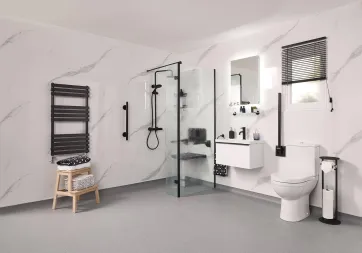
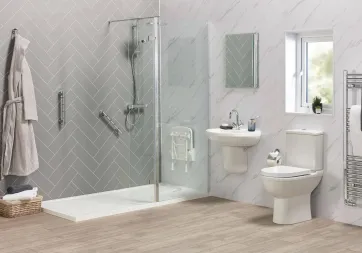
This is the standard for most of our wet room installations. We remove the pedestal entirely and mount the basin directly to the wall.
- The Benefit: It creates Clear Knee Space. You can roll your wheelchair right underneath the sink, allowing you to get your chest close to the rim without twisting your back.
- The “Hidden” Engineering: You cannot just bolt a heavy ceramic sink to a standard plasterboard wall. As part of your renovation, we open up the wall and install a Steel Support Frame or timber noggins. This ensures the sink can support your weight if you lean on it heavily.
- Safety Detail: We use a Chrome Bottle Trap (waste pipe) that sits close to the wall, so it doesn’t snag on your legs or wheelchair wiring.
Thinking about a safer bathroom?
Book a free, no-obligation home visit anywhere in the UK. We assess the room, check whether you qualify for 0% VAT, and leave you a fixed-price quote to think about in your own time.
 Book a Free Home Assessment
Which? Trusted Trader · Free home visits across the UK · Lifetime installation guarantee · 0% VAT if you qualify
2. The “Rise & Fall” Basin (Maximum Flexibility)
If you live in a multi-generational home (e.g., a wheelchair user and a standing partner), a fixed height sink is a compromise for someone.
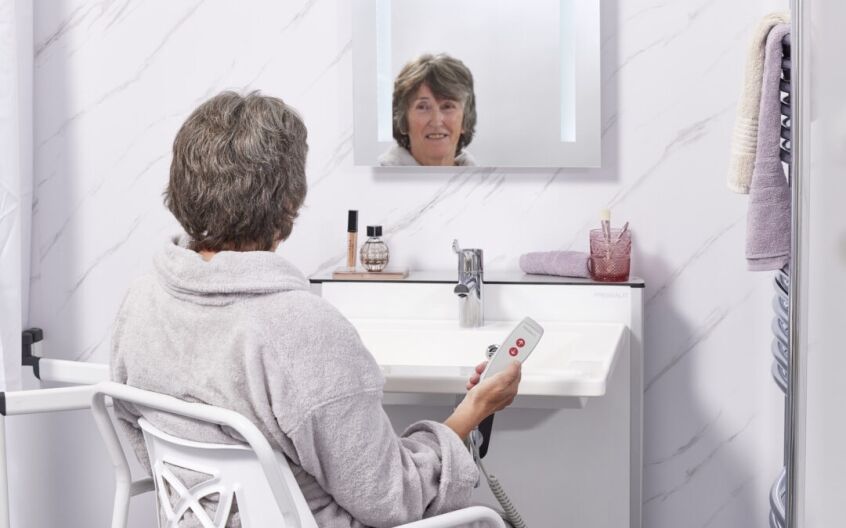
- The Solution: An Electric Rise & Fall Basin.
- How it works: At the touch of a button (or a large paddle switch), the entire sink unit moves up and down.
- Low setting: For the seated user (approx 700mm).
- High setting: For the standing user (approx 850mm+).
- The Integration: Modern units have a mirror and light attached that move with the sink, so you can always see yourself, regardless of height.
3. The “Finger Rinse” Basin (For Toilets)
If we are adapting a small downstairs toilet or cloakroom, space is tight.
- The Rule: A wheelchair user should be able to wash their hands while sitting on the toilet (to maintain hygiene before transferring back to the chair).
- The Solution: A compact, wall-mounted basin located within the “Transfer Zone,” plumbed into the side wall.
Critical Safety Features
A basin is more than a bowl. The engineering defines the safety.
1. Anti-Scald Safety (TMV3)
Hot water can cause serious burns in seconds on elderly skin.
- The Fix: We install Thermostatic Mixing Valves (TMV3) under the sink. This blends the hot water to a safe maximum (41°C) before it reaches the tap.
2. Insulated Waste Pipes
If you have reduced sensation in your legs (e.g., paralysis or diabetes), you might rest your knees against the hot waste pipe without feeling it burn.
- The Fix: We insulate the underside of the basin or use “Cool Touch” traps to prevent contact burns.
3. Lever vs. Sensor Taps
Twist knobs are painful for arthritic fingers.
- The Fix: Long-Lever Taps (quarter turn) can be operated with an elbow.
- The Upgrade: Infra-Red Sensor Taps. Zero touch. Water flows when you put your hands under. Perfect for weak grip.
Why We Don’t Sell Sinks “Supply Only”
We often get asked if we can just send a basin for a local handyman to fit.
The answer is No.
Installing a cantilevered (floating) sink requires structural wall reinforcement. If a handyman screws it into drywall, and you lean on it for support, it could rip off the wall and cause serious injury.
We only install basins as part of a full bathroom adaptation where we can guarantee the structural integrity of the wall behind the tiles.
How Much Does It Cost?
Because these are installed as part of a project (like a Wet Room or Walk-In Bath), the cost is wrapped into the total renovation price.
- Standard Wall-Hung Setup: Adds approx £500–£800 to your bathroom quote.
- Electric Rise & Fall Unit: Adds approx £2,000–£3,500 to your bathroom quote.
- Funding Note: If the adaptation is for a disability, the entire project (including the basin) is VAT Exempt (0%).
Frequently Asked Questions
Q: Can I use my existing sink?
A: Usually, No. Standard sinks are designed to sit on a pedestal. They often lack the structural strength to hang on a wall safely. We recommend a dedicated wall-hung ceramic or resin basin.
Q: What is the correct height for a disabled basin?
A: For a seated user, the rim is typically set at 720–740mm from the floor. However, our surveyors measure your specific wheelchair height during the home survey to get it perfect.
Q: Are Rise & Fall basins noisy?
A: No. Modern units use silent linear actuators. They are smooth, quiet, and reliable.
Reclaim Your Routine
Washing your face shouldn’t require an acrobat’s balance.
Our surveyor will measure your knee clearance and reach range to recommend the perfect basin setup as part of your new accessible bathroom.

Simon
Clients’ Needs Assessor
Simon brings extensive experience from the healthcare sector, having spent over 25 years working alongside physiotherapists and occupational therapists.
Free · No obligation · UK-wide
Ready for a safer, easier bathroom?
Tell us a little about your bathroom and one of our own surveyors will visit at a time that suits you, anywhere in the UK. You'll get honest advice and a fixed-price quote to consider in your own time.
- Rated 4.9 by Which? Trusted Traders
- Our own installers, never subcontracted
- 0% VAT on eligible installations
- Lifetime installation guarantee
Prefer to talk? Call free on 0800 955 8810