

Last Updated on October 13, 2026
The standard disabled toilet size in the UK is 2200mm x 1500mm (based on Building Regulations Part M).
But here’s what most people don’t realise:
👉 You do NOT need this much space in a typical UK home.
In fact, most domestic disabled toilets are designed to fit smaller bathrooms, while still being safe, practical, and comfortable to use.
If you’re wondering:
- “Will my bathroom be big enough?”
- “Do I need to follow Doc M exactly?”
- “Can I fit this into a small space?”
You’re in the right place.
Disabled Toilet Dimensions (Quick Answer)
If you just want the key measurements, here they are:
| Feature | Recommended Size |
| Standard (Doc M) | 2200mm x 1500mm |
| Minimum door width | 850mm (900mm ideal) |
| Transfer space beside toilet | 750mm minimum |
| Toilet height | ~480mm (comfort height) |
| Basin height | 720–740mm |
👉 These are the gold standard guidelines, but not always required at home.
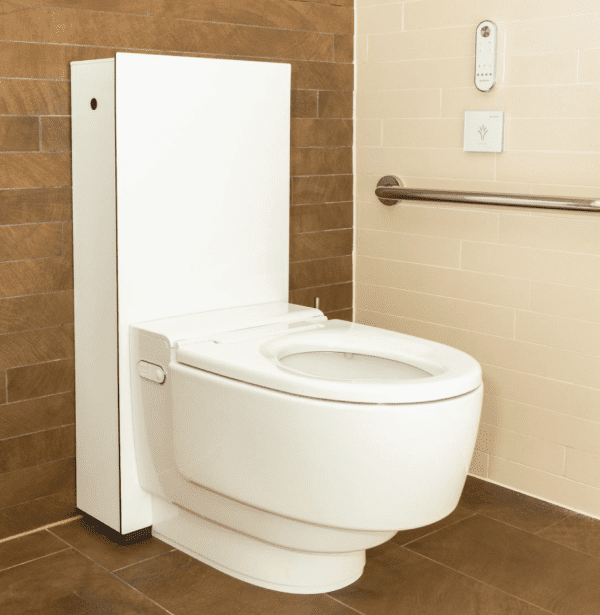
Explore our smart toilets with cutting-edge features, offering improved hygiene, comfort, and convenience for every bathroom.
Do You Need Doc M Sizes at Home?
Short answer: No.
Doc M regulations apply to:
- Public buildings
- Commercial spaces
- Offices, shops, venues
In a private home, the focus is different:
✔ What works for you
✔ How you move
✔ How you transfer safely
This means a disabled toilet can often be designed into:
- Smaller bathrooms
- Cloakrooms
- Downstairs WCs
👉 Without compromising independence
The 2200mm x 1500mm layout exists for one reason:
👉 To allow a full wheelchair turning circle + transfer space
This includes:
- Entry space
- Turning area
- Positioning beside the toilet
Perfect for public use, but often more than needed in homes.
Want it fitted properly, first time?
Rails, raised toilets, seats and ramps only help if they're positioned for the person using them. Book a free home visit and our surveyor will assess the room and recommend exactly what you need, with a fixed-price quote.
 Book a Free Home Assessment
Which? Trusted Trader · Free home visits across the UK · Lifetime installation guarantee · 0% VAT if you qualify
The Most Important Measurement (Most People Miss This)
👉 Transfer Space Beside the Toilet
This matters more than overall room size.
To use a toilet safely from a wheelchair, you need space to transfer sideways.
- Minimum: 750mm clear space
- Ideal: 800–900mm
This space:
- Sits on one side of the toilet
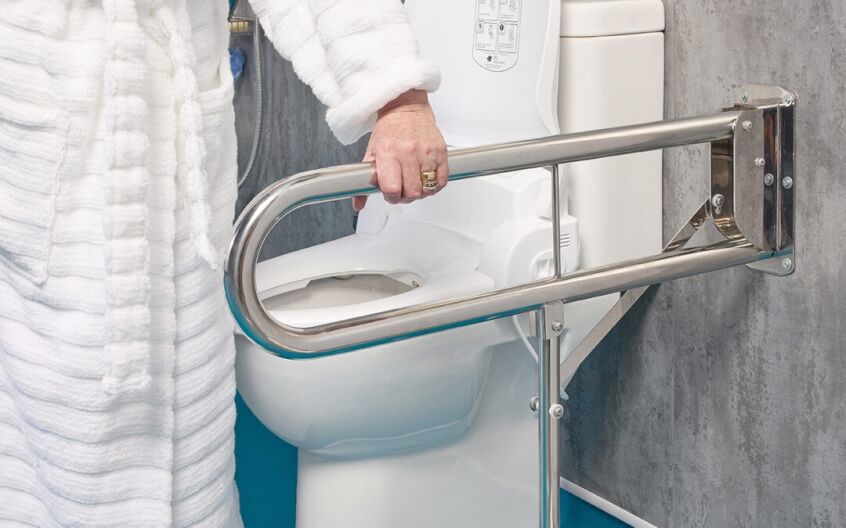
- Includes a drop-down support rail
- Is tailored to your stronger side (left or right)
👉 This is what actually makes a bathroom usable.
Can You Fit a Disabled Toilet in a Small Bathroom?
Yes. In many cases, you can.
Here’s how it typically works in UK homes:
✔ If you use a wheelchair:
- Focus on access route + transfer space
- Turning circle may not be needed
✔ If you are ambulant (use a frame or stick):
- Room can be much smaller
- Grab rails become more important than space
✔ If space is tight:
- Layout is redesigned around:
- Door position
- Toilet placement
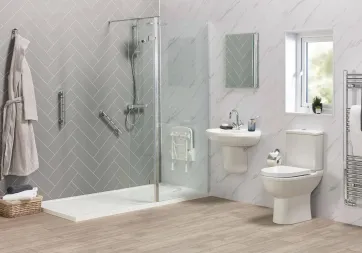
- Wall-hung basin
👉 This is why bespoke design matters.
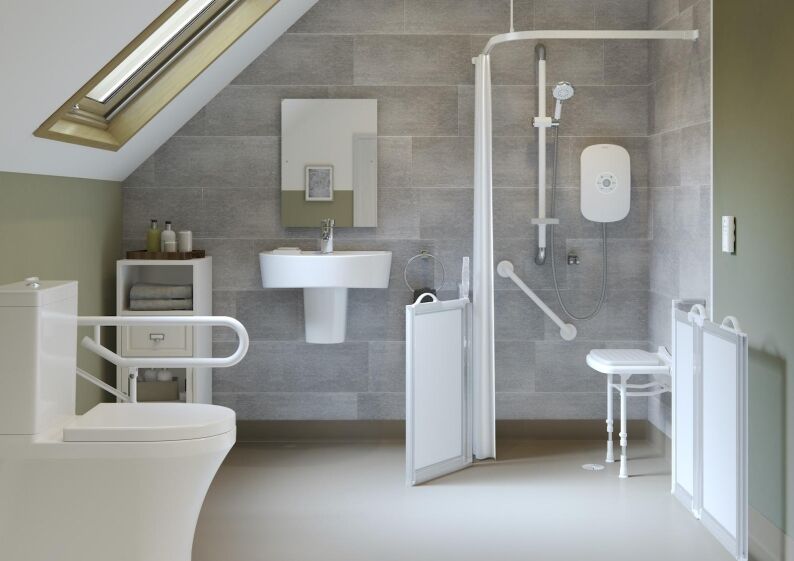
Barrier-free, slip-resistant, and designed for independent living.
Door Width & Access (Often Overlooked)
Even a perfect layout won’t work if access is restricted.
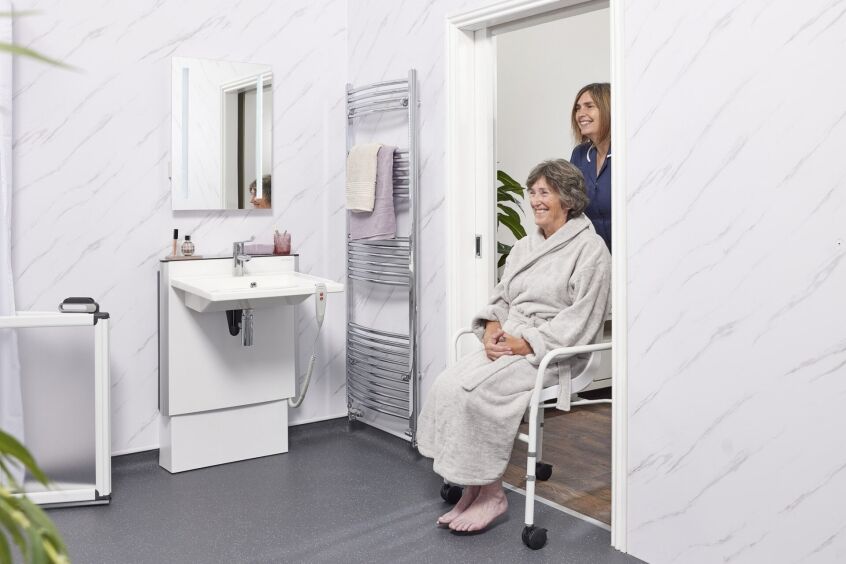
- Minimum door width: 850mm
- Ideal: 900mm+
Best door options:
- Outward-opening doors
- Sliding (pocket) doors
👉 These improve safety if someone falls inside.
Standard Heights for a Safe Setup
Getting the height right makes a huge difference to comfort and safety.
| Fixture | Standard Height (from floor) | Notes |
| Toilet Pan | 480mm | Standard “Comfort Height” level. |
| Wash Basin | 720–740mm | Must be wall-hung to allow knees underneath. |
| Grab Rails | 680mm | Horizontal rails for support. |
| Mirror | 1000mm (Bottom edge) | Long mirror so seated users can see. |
| Paper Holder | 600–700mm | Easy reach, usually on the wall rail. |
👉 These allow easier sitting, standing, and reach.
- Learn more about Comfort Height Toilets vs Raised Seats here.
Safety Features You Should Never Skip
1. Emergency Pull Cord
- Must reach the floor (100mm height)
- Also reachable from seated position
👉 This is critical in case of a fall.
2. Non-Slip Flooring
Look for:
- R11 or R12 rating
Avoid:
- Glossy tiles
- Polished surfaces
👉 Slips are one of the biggest risks in bathrooms.
3. Visual Contrast (For Dementia & Low Vision)
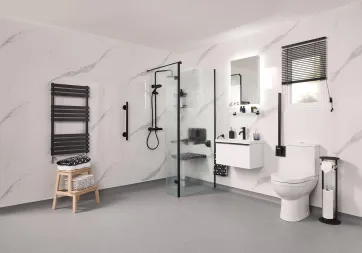
- Dark rails on light walls (or vice versa)
- Avoid white-on-white
👉 Helps users identify key support points easily.
What is a “Doc M Pack”?
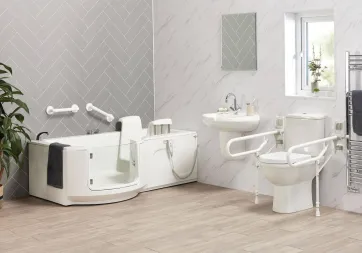
A Doc M pack is a pre-designed set of accessible bathroom equipment, usually including:
- Raised height toilet
- Wall-hung basin
- Grab rails
- Drop-down support rail
Many standard packs look quite clinical.
👉 In modern homes, these can be upgraded to:
- Chrome
- Matte black
- Brushed steel
So your bathroom still feels like a home, not a hospital
Real UK Scenario: What We See in Homes
Most UK properties don’t have space for full Doc M layouts.
Instead, we typically:
- Reposition the toilet to create transfer space
- Use wall-hung basins to free up room
- Adjust door openings
- Design around how the person actually moves
👉 This creates a layout that works in real life, and not only on paper.
Frequently Asked Questions
What is the minimum disabled toilet size in the UK?
There is no fixed minimum for homes. The space must allow safe access and transfer, usually with at least 750mm beside the toilet.
Can a disabled toilet be smaller than 2200mm x 1500mm?
Yes. That size is for public buildings. Domestic bathrooms are often smaller but still fully functional.
Do I need a special toilet?
A comfort height toilet (~480mm) is usually recommended. In some cases, wash and dry toilets are used for added independence.
Can I convert a small cloakroom?
In many cases, yes. Layout changes and smart design can make smaller spaces work effectively.
Do I need planning permission?
Usually no. Most internal adaptations fall under permitted development, though building regulations may apply.
Not Sure If Your Bathroom Will Work?
Every home is different, and sometimes just a few centimetres can make all the difference.
At EA Mobility, we:
- Laser-measure your space
- Assess how you move and transfer
- Design a layout that maximises safety and independence
👉 Even in smaller or awkward rooms.
👉 Book a Free Home Assessment
If you’re unsure what’s possible in your space, we can help you figure it out clearly, with no guesswork.

Simon
Clients’ Needs Assessor
Simon brings extensive experience from the healthcare sector, having spent over 25 years working alongside physiotherapists and occupational therapists.
Free · No obligation · UK-wide
Ready for a safer, easier bathroom?
Tell us a little about your bathroom and one of our own surveyors will visit at a time that suits you, anywhere in the UK. You'll get honest advice and a fixed-price quote to consider in your own time.
- Rated 4.9 by Which? Trusted Traders
- Our own installers, never subcontracted
- 0% VAT on eligible installations
- Lifetime installation guarantee
Prefer to talk? Call free on 0800 955 8810