

Last Updated on October 13, 2026
The Heart of the Home: Designing a Kitchen Without Limits
For many wheelchair users, the kitchen is the most frustrating room in the house. Worktops are too high, cupboards are unreachable, and carrying a kettle across the room feels like a dangerous obstacle course.
But you shouldn’t have to rely on microwave meals or family members to cook for you.
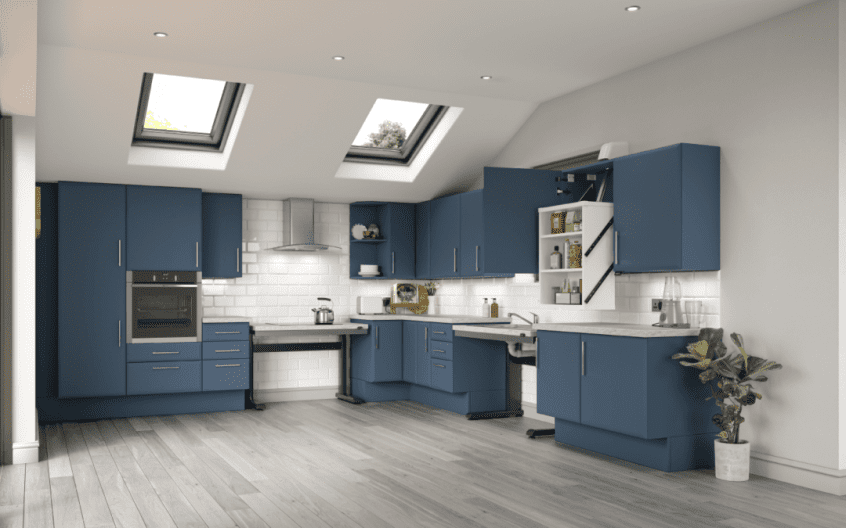
At EA Mobility, we design Adaptive Kitchens that blend high-end style with smart engineering. We understand that a kitchen isn’t just about cooking; it’s about being part of family life.
Whether you need a fully automated kitchen or just a safer layout, here is the definitive guide to the essential features of a modern accessible kitchen in 2026.
Looking to have an accessible kitchen fitted? This guide covers design ideas. To see how we design and install accessible kitchens for wheelchair users and disabled people, with a free home visit, visit our Accessible Kitchens page.
1. The Layout: The “Turning Circle” Rule
Before we look at gadgets, we need to fix the floorplan.
- The 1500mm Rule: A standard wheelchair needs a clear circle of 1500mm to turn 360 degrees. We often remove islands or peninsulas to open up the floor.
- The “Recessed Plinth” (Crucial Detail): Standard kitchen units have a kickboard (plinth) at the bottom. This hits your wheelchair footrests, stopping you from getting close to the counter.
- The Fix: We install High-Recess Plinths or mount units on legs. This allows your footrests to slide under the cupboard, letting you work comfortably.
- Continuous Countertops: We design the worktop to connect the sink and hob. This allows you to slide a heavy pan along the surface rather than lifting it.
2. Rise & Fall Worktops (The Family Solution)
Standard worktops are 900mm high. That is too high for a seated user (who needs approx 720mm), but perfect for a standing partner.
- The Solution: Electric Rise & Fall Worktops.
- How it works: At the touch of a button, the entire counter (including the sink and hob) lowers to your lap height or rises for standing family members.
- Why it’s essential: It makes the kitchen usable for the whole family, future-proofing the home without making it look “specialist.”
Thinking about a safer bathroom?
Book a free, no-obligation home visit anywhere in the UK. We assess the room, check whether you qualify for 0% VAT, and leave you a fixed-price quote to think about in your own time.
 Book a Free Home Assessment
Which? Trusted Trader · Free home visits across the UK · Lifetime installation guarantee · 0% VAT if you qualify
3. The Cooking Zone: Removing the Danger
Cooking from a wheelchair carries risks (burns, spills). We mitigate these with technology.
The Induction Hob
- Why: Gas flames are dangerous at eye level. Electric plates stay hot for ages.
- The Fix: Induction Hobs heat the pan, not the glass. They cool down instantly, preventing burns if you lean on them.
The “Slide & Hide” Oven
- The Problem: A standard oven door opens downwards, blocking your wheelchair and forcing you to lean over a hot door to reach the turkey.
- The Fix: We install Side-Opening ovens or Slide & Hide doors (like Neff) that disappear underneath the oven.
- Heat-Resistant Pull-Out Shelf: We install a shelf directly under the oven. You slide the hot dish out onto the shelf to rest, without lifting.
4. The Wet Zone: Sinks & Boiling Taps
The “Safe Sink”
- Knee Space: We leave the space under the sink open (no cupboard) so you can wheel right in.
- Insulated Bowl: We insulate the underside of the stainless steel bowl to prevent you from burning your knees on hot water piping.
- Shallow Depth: A shallow sink means you don’t have to reach deep down to scrub pots.
The Boiling Water Tap (Quooker)
- The Danger: Filling, lifting, and pouring a heavy kettle of boiling water is a major scald risk for weak hands.
- The Fix: A Boiling Water Tap delivers tea-ready water instantly at the sink. No lifting, no carrying, no scalds.
5. Smart Storage & Electrics
- Pull-Down Baskets: We install internal mechanisms (“iMove”) that bring the contents of the top shelf down to you.
- Deep Drawers: Instead of base cupboards (where you have to dig around at the back), we use deep, soft-close drawers. You can see everything at a glance.
- Socket Heights: Following Part M regulations, we place electrical sockets on the front fascia of the worktop or lower on the wall, so you don’t have to stretch over the counter to plug in a toaster.
How Much Does an Accessible Kitchen Cost?
A bespoke kitchen is a significant investment, comparable to a high-end standard kitchen renovation.
- Adaptation (Worktops & Appliances): £8,000–£12,000.
- Full Kitchen Renovation: £15,000–£25,000+.
Funding:
- VAT Exemption (0%): If the work is critical for your disability (e.g. you cannot feed yourself without it), you do not pay VAT on the installation.
- Disabled Facilities Grant (DFG): Kitchens are a “Primary Need.” You can apply for a council grant of up to £30,000 to cover the cost.
Note: Grants wording along the lines of Grant applications can be complex and lengthy, often taking 1-2 years to process and requiring detailed eligibility and project criteria. Therefore, we are unable to support these processes and thus our services are focused on clients funding their projects personally so that we can work in a reasonable timescale to offer our clients the best service. We recommend you contact your local council for assistance.
Frequently Asked Questions
Q: Can I adapt my existing kitchen?
A: Sometimes. We can lower existing worktops or remove base units to create knee space. However, fitting heavy Rise & Fall mechanisms usually requires new, reinforced cabinetry to hold the weight of the motor.
Q: Does it look “Medical”?
A: Absolutely not. We use the same high-gloss, matte, or wood finishes as a luxury showroom kitchen. The accessibility features are hidden inside the design.
Q: What flooring is best?
A: We recommend R10/R11 Anti-Slip Vinyl. Tiles can be slippery and cold. Vinyl is durable for wheelchair tires, warmer if you drop a plate, and easier to clean.
Cook with Confidence Again
You provide the recipes; we’ll provide the kitchen.
Our surveyors understand the ergonomics of wheelchair use. We will measure your reach range, eye level, and turning circle to design a kitchen that fits you like a glove.

Michael
Clients’ Needs Assessor at EA Mobility
With over 20 years of experience in the mobility sector, he has helped change the lives of thousands of people, helping them regain independence through essential property adaptations.
Free · No obligation · UK-wide
Ready for a safer, easier bathroom?
Tell us a little about your bathroom and one of our own surveyors will visit at a time that suits you, anywhere in the UK. You'll get honest advice and a fixed-price quote to consider in your own time.
- Rated 4.9 by Which? Trusted Traders
- Our own installers, never subcontracted
- 0% VAT on eligible installations
- Lifetime installation guarantee
Prefer to talk? Call free on 0800 955 8810