

Last Updated on October 13, 2026
The bathroom is one of the most challenging and highest-risk rooms in the home for someone living with Parkinson’s. Wet, slippery surfaces, a high bath wall to climb over, fiddly taps and tight spaces can all make daily bathing harder and increase the risk of a fall. The good news is that the right bathroom adaptations for Parkinson’s can make a real difference, restoring safety, dignity and independence.
As a proud partner of Parkinson’s UK, EA Mobility understands that no two people experience Parkinson’s in the same way. This guide explains how the condition affects bathroom use and the practical adaptations that help, so you or your loved one can keep bathing comfortably and confidently at home.
How Parkinson’s Affects Bathroom Use
Parkinson’s affects movement in ways that make a standard bathroom difficult to use safely. Understanding these challenges is the first step to designing a space that works with the condition rather than against it:
- Tremor and reduced grip can make turning taps, holding shower handles and managing small fittings frustrating.
- Slowness of movement (bradykinesia) and stiffness (rigidity) make getting in and out of a bath, sitting down and standing up slow and tiring.
- Balance problems and “freezing”, where the feet feel momentarily stuck, are often triggered by doorways, thresholds, turning and tight spaces, all common in bathrooms.
- Fatigue and “on/off” fluctuations mean mobility can change throughout the day, so the bathroom needs to be safe even on more difficult days.
- Urinary urgency and night-time trips to the toilet increase the number of trips to the bathroom, and with them the risk of a fall in the dark.
- Dizziness on standing can affect getting up from a seat or rising in the shower.
Because Parkinson’s is a progressive condition, it’s also wise to plan for changing needs by adapting the bathroom once, with the future in mind, rather than repeatedly.
Key Bathroom Adaptations for Parkinson’s
1. Remove the step: level-access showers and wet rooms
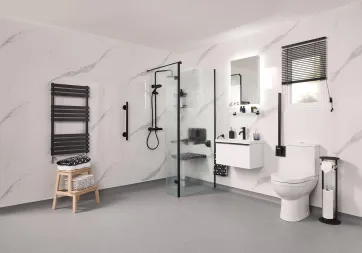
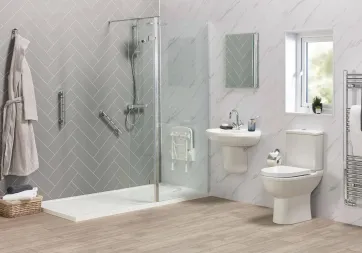
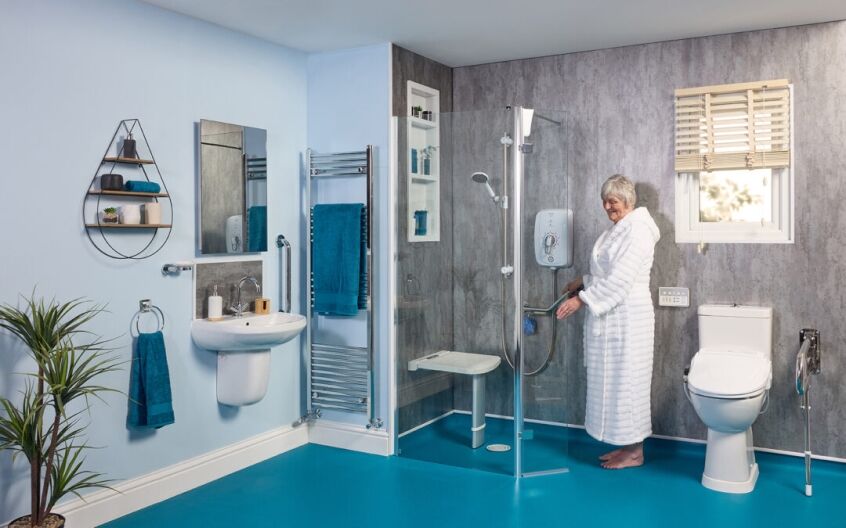
Eliminating the step over a bath or shower tray is one of the single most effective safety changes. A level-access wet room or level access shower removes the threshold entirely, reducing trip hazards and helping with the freezing that doorways and steps can trigger. The open, barrier-free layout also gives plenty of room to move and turn safely.
2. Choosing between a walk-in shower and a walk-in bath
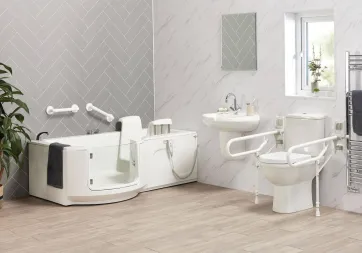
For many people with Parkinson’s, a walk-in shower is the most practical choice. It’s quick, easy to use on tiring days and simple for a carer to assist with. That said, some people find the warmth of a soak helps with stiffness, in which case a walk-in bath with a low threshold and powered seat may suit. Our guide to choosing between a walk-in bath and a walk-in shower looks at this decision in more detail.
3. Secure, comfortable seating
Being able to sit while washing conserves energy and dramatically improves safety on days when balance or fatigue is an issue. A sturdy fold-down shower seat or a built-in bath seat means bathing doesn’t depend on standing for long periods.
4. Grab rails and support poles in the right places
Well-positioned grab rails provide reassurance and support exactly where they’re needed: at the shower entry, beside the seat and near the toilet. For extra support without drilling into walls, a floor-to-ceiling support pole can offer a stable handhold at key transfer points. Placement matters far more than quantity, which is why a proper assessment is so valuable.
5. Slip-resistant flooring
Anti-slip flooring is essential in a bathroom used by someone with Parkinson’s. It provides grip even when wet and removes the loose bath mats that are a common trip and freezing hazard.
6. Easy-to-use taps and controls
Tremor and reduced grip make traditional twist taps difficult. Lever or single-action taps, larger easy-grip controls and a thermostatic, anti-scald shower valve all make the bathroom safer and far less frustrating to use. They also protect against accidental scalding when reactions are slower.
7. An accessible toilet
A comfort-height toilet makes sitting down and standing up easier, while grab rails alongside provide support. For those who find wiping and personal care difficult because of tremor or limited dexterity, a wash-and-dry smart toilet can help maintain dignity and independence. Because urinary urgency and night-time visits are common with Parkinson’s, a safe, easy-to-reach toilet really matters.
8. Good lighting and colour contrast
Bright, even lighting reduces shadows and trip hazards, and is especially useful for night-time visits. Using colour contrast, for example a toilet seat, grab rails or shower seat in a tone that stands out from the background, helps with the visual perception difficulties some people with Parkinson’s experience, and can make fixtures easier to locate and use.
9. Space for a carer or wheelchair
An open, uncluttered layout with room to manoeuvre helps reduce freezing, allows a carer to assist comfortably and keeps the bathroom usable if mobility needs increase over time. Clearing clutter and keeping a wide, simple route through the room makes everyday movement easier.
Planning a walk-in shower or wet room?
Our surveyors design and fit accessible bathrooms across the UK. Book a free home visit: we plan the layout with you, check whether you qualify for 0% VAT, and give you a fixed-price quote with no obligation.
 Book a Free Design Visit
Which? Trusted Trader · Free home visits across the UK · Lifetime installation guarantee · 0% VAT if you qualify
Future-Proofing the Bathroom
Because Parkinson’s changes over time, the smartest approach is to design a bathroom that works now and adapts to the future. That might mean fitting reinforced walls ready for additional rails, leaving space for a wheelchair or carer, or choosing a layout that can accommodate further aids later. Adapting thoughtfully once is less disruptive, and more cost-effective, than making repeated changes.
An occupational therapist can assess individual needs, and our own design team takes the time to understand how Parkinson’s affects you specifically before recommending anything.
Save 20% with VAT Relief
Parkinson’s is a qualifying condition for VAT relief, which means an accessible bathroom adaptation can usually be supplied and installed at 0% VAT, saving 20% on the total cost. It isn’t means-tested, and we handle the paperwork for you.
Why Choose EA Mobility
EA Mobility is a family-run business with over 20 years of experience and 7 years as an endorsed Which? Trusted Trader. As an official Parkinson’s UK partner, we offer people living with Parkinson’s a 10% discount on all home adaptations, and we make a donation to Parkinson’s UK to support vital research with every project.
In the words of Sue Mills, Trading Manager at Parkinson’s UK, the charity partners “only with best-in-class companies,” choosing EA Mobility for our customer-centric approach and consistently high standards. One customer living with Parkinson’s, Mr Tomlinson, described his bath-to-shower conversion as “a game-changer”. It was practical, safe and finished sooner than expected, with grab rails giving him the confidence he needed.
Every installation includes a free, no-obligation home visit from a caring, DBS-checked assessor, 3D CAD design so you can see your new bathroom before work begins, and our Lifetime Installation Guarantee.
Ready to make bathing safer? Call our friendly team free on 0800 955 8810. We also support people living with multiple sclerosis as a proud MS Society partner.
This guide offers general information on home adaptations and is not medical advice. For advice tailored to your symptoms, speak to your GP, Parkinson’s nurse or an occupational therapist.
Frequently Asked Questions
What is the best bathroom adaptation for someone with Parkinson’s?
There’s no single answer, but removing the step with a level-access shower or wet room is usually the most impactful change, combined with a secure seat, well-placed grab rails, slip-resistant flooring and easy-to-use taps. The right mix depends on the individual’s symptoms and home.
Is a walk-in shower or walk-in bath better for Parkinson’s?
A walk-in shower is often the more practical choice as it’s quick, easy on tiring days and simple for a carer to assist with. A walk-in bath can suit those who find a warm soak helps with stiffness. A home assessment helps determine the best option.
Can people with Parkinson’s get VAT relief on a bathroom?
Yes. Parkinson’s is a qualifying condition, so an accessible bathroom adaptation can usually be supplied and installed at 0% VAT, saving 20%. It isn’t means-tested and the paperwork is straightforward.
Does EA Mobility offer a discount for people with Parkinson’s?
Yes. As a Parkinson’s UK partner, EA Mobility offers people living with Parkinson’s a 10% discount on all home adaptations, and makes a donation to Parkinson’s UK with every project.
How can I reduce falls in the bathroom for someone with Parkinson’s?
Remove steps and loose mats, fit slip-resistant flooring and well-positioned grab rails, provide secure seating, improve lighting for night-time visits, and keep the layout open and uncluttered to reduce freezing and trip hazards.

Denleigh Carvell
Project Manager at EA Mobility
Denleigh oversees projects across the UK, from walk-in baths and low-level showers to wet rooms, making homes safer and more accessible.
Free · No obligation · UK-wide
Ready for a safer, easier bathroom?
Tell us a little about your bathroom and one of our own surveyors will visit at a time that suits you, anywhere in the UK. You'll get honest advice and a fixed-price quote to consider in your own time.
- Rated 4.9 by Which? Trusted Traders
- Our own installers, never subcontracted
- 0% VAT on eligible installations
- Lifetime installation guarantee
Prefer to talk? Call free on 0800 955 8810