

Last Updated on September 25, 2026
A step at the front door, a raised patio or a lip at the back door can stop a wheelchair user getting in and out of their own home. The right ramp removes that barrier, but only if it is the right type, the right length and fitted in the right place. This guide explains the options, how steep a ramp can safely be, and what to check before you choose one.
The short answer: for a small lip or door sill, a threshold ramp is usually enough. For one or two steps, a portable or modular ramp works well. For several steps or a sloping, awkward site, you need a longer modular or bespoke ramp with level landings and handrails. As a guide, a ramp should be no steeper than 1 in 12, so every 10cm of height needs at least 1.2m of ramp.
The Main Types of Wheelchair Ramp for the Home
| Type | Best for | Good to know |
| Threshold ramp | Door sills, patio door tracks and small lips | Small, low wedge that sits against the sill. Often the quickest fix for internal and back doors. |
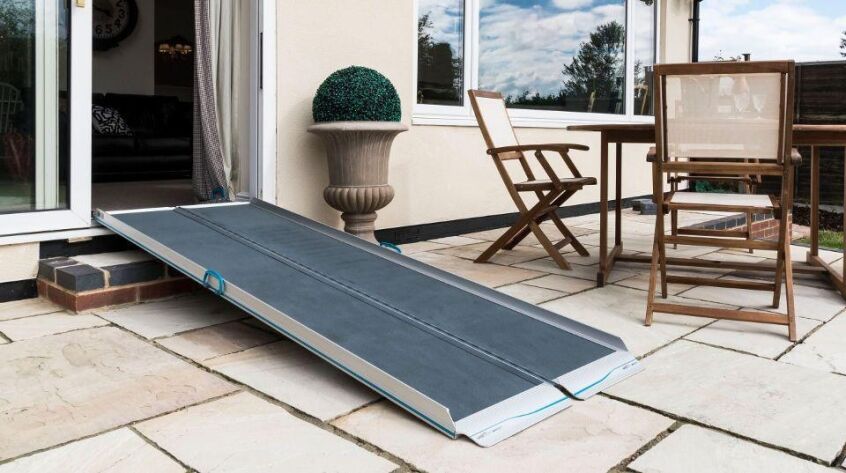
| Portable (folding) ramp | A single step, a kerb or getting into a vehicle | Lightweight and folds away. Needs setting up each time, so it suits occasional use. |
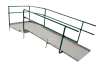
| Modular ramp | Several steps at a front or back door, used every day | Built from sections with landings and handrails. Needs little or no groundwork and can be adapted or removed later. |
| Bespoke ramp | Sloping, narrow or awkward sites | Designed after a survey to fit the site. Also removable or adaptable as needs change. |
How Steep Can a Wheelchair Ramp Be?
The gentler the slope, the easier and safer the ramp is to use, whether you push yourself, use a powered chair or have a carer pushing. As a guide, 1 in 12 is the steepest a ramp at home should be, and 1 in 15 or gentler is better for longer ramps or for anyone who self-propels.
Building Regulations guidance for new homes (Approved Document M) uses the same figures: no steeper than 1 in 12 for a ramp up to 5m long, and 1 in 15 for a ramp up to 10m long, with a level landing at the top and bottom.
How long does the ramp need to be? Measure the total height of the step or steps, then multiply:
- A 15cm step at 1 in 12 needs a ramp of about 1.8m.
- A 30cm rise (two steps) at 1 in 12 needs about 3.6m, or 4.5m at 1 in 15.
This is why a ramp for more than one or two steps usually needs to turn a corner or double back, with a landing in between. It is also why a very short, steep ramp is one of the most common mistakes we see.
Want it fitted properly, first time?
Rails, raised toilets, seats and ramps only help if they're positioned for the person using them. Book a free home visit and our surveyor will assess the room and recommend exactly what you need, with a fixed-price quote.
 Book a Free Home Assessment
Which? Trusted Trader · Free home visits across the UK · Lifetime installation guarantee · 0% VAT if you qualify
What Else to Check Before You Choose
- Width. Allow a clear width of at least 900mm between handrails, and more for a larger powered chair.
- Landings. A level landing at the top and bottom, and in front of the door, gives space to stop, turn and open the door safely. Longer ramps also need resting landings part way up.
- Handrails and edges. Handrails help walking-aid users and carers, and a raised edge stops wheels running off the side.
- Surface. Choose a slip-resistant surface that drains, so it stays safe in rain and frost.
- Who will use it. Someone who walks with a frame may find a gentle ramp harder than a well-designed step with rails. We look at how each person moves before recommending a solution.
Do You Need Planning Permission for a Ramp?
Portable and threshold ramps do not need permission. Most modular ramps at the side or back of a house do not either, but a permanent ramp that raises a platform more than 30cm above the ground, sits at the front of the house, or is on a listed building or in a conservation area may need permission. If you are unsure, check with your local council before work starts. We can advise on this at the survey.
Can You Get VAT Relief on a Wheelchair Ramp?
Yes. If you have a long-term condition or disability, building a ramp at your home is usually zero-rated for VAT, which saves 20%. Our guide to 0% VAT on mobility adaptations explains who qualifies.
How EA Mobility Can Help
We supply and fit wheelchair ramps for homes across the UK, from portable and threshold ramps to modular and bespoke systems with landings and handrails. All our ramp systems can be adapted or removed as needs change, leaving little or no mark on the ground. Many customers pair a ramp with an accessible bathroom, such as a level-access wet room, so the whole home works for a wheelchair.
Book a free home visit or call 0800 955 8810. We will measure the rise, check the site and recommend the simplest ramp that works.
Frequently Asked Questions
What is the best wheelchair ramp for a front door step?
For a single step, a portable ramp or a short modular ramp with a level landing at the door usually works best. For a small sill only, a threshold ramp is often enough.
How wide should a wheelchair ramp be?
Allow at least 900mm clear width between handrails for a standard wheelchair, and more for a large powered chair or if a carer walks alongside.
What gradient should a home wheelchair ramp be?
No steeper than 1 in 12, and ideally 1 in 15 or gentler for longer ramps or for someone who pushes themselves.
Can a ramp be removed later?
Yes. Portable, threshold and modular ramps can all be removed or adapted, and our bespoke ramps are built from modular parts so they can be changed later too.

Simon
Clients’ Needs Assessor
Simon brings extensive experience from the healthcare sector, having spent over 25 years working alongside physiotherapists and occupational therapists.
Free · No obligation · UK-wide
Ready for a safer, easier bathroom?
Tell us a little about your bathroom and one of our own surveyors will visit at a time that suits you, anywhere in the UK. You'll get honest advice and a fixed-price quote to consider in your own time.
- Rated 4.9 by Which? Trusted Traders
- Our own installers, never subcontracted
- 0% VAT on eligible installations
- Lifetime installation guarantee
Prefer to talk? Call free on 0800 955 8810