

Last Updated on September 14, 2026
The Great Debate: Is a Wet Room Right for Your Mobility Needs?
If you are struggling to get in and out of a standard bathtub, you know something needs to change. But is a full wet room the right answer?
At EA Mobility, we work alongside Occupational Therapists (OTs) every day. We know that while a wet room is the “Gold Standard” for accessibility, it is a significant renovation.
To help you decide, we have compiled the definitive guide to the Benefits, Drawbacks, and Safety Features—consolidating everything you need to know in one honest article. If you’d rather see our disabled wet rooms in more detail first, you can explore the full range here.
Quick answer
A wet room for the elderly or disabled is a fully tanked bathroom with a level, step-free floor that drains the whole room, so there is no tray, lip or door to get past. Its main benefits are zero-threshold access for wheelchairs and walking frames, easier assisted bathing for carers, lower water use than a bath, and simpler cleaning. The main drawbacks—cold floors, splashing and higher cost—are all solvable with underfloor heating, glass zoning panels and 20% VAT relief for eligible customers.
Key takeaways
- A true wet room has a 0mm threshold; even a “level-access” shower tray usually has a 40–100mm lip.
- Wet rooms are the most practical format for carer-assisted washing and wheelchair users.
- Swapping a bath (around 80 litres) for a 5-minute shower (35–45 litres) roughly halves hot water use.
- Five OT-approved safety features: R11+ flooring, thermostatic cool-touch valves, correctly positioned grab rails, tempered safety glass, and an outward-opening or sliding door.
- Installation typically takes 3–5 days; around 60% of EA Mobility wet rooms are fitted upstairs.
- Qualifying customers pay no VAT (a 20% saving) and may be eligible for a Disabled Facilities Grant of up to £30,000 in England.
Last reviewed: 14 September 2026 by Denleigh Carvell, Project Manager at EA Mobility. EA Mobility has been a Which? Trusted Trader for 8 consecutive years and is a partner of Parkinson’s UK and the MS Society.
In this guide
Part 1: The Basics (Definition)
What Exactly Is a Wet Room?
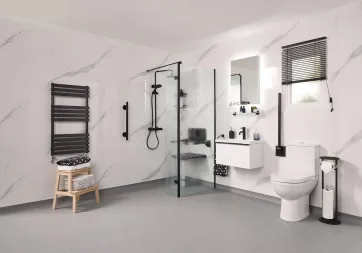
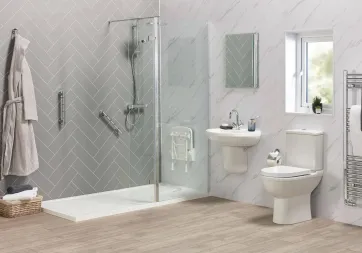
A wet room is a fully waterproofed (tanked) bathroom where the shower area is completely level with the rest of the floor. There is no shower tray and no step. The drain is built into the floor structure, meaning the entire room becomes the shower enclosure, offering barrier-free access for wheelchairs and walking frames.
Part 2: The 5 Big Benefits (The Pros)
1. Total Future-Proofing (Zero Threshold)
A standard “walk-in shower” tray still has a lip of 40mm–100mm.
- The Benefit: A true wet room has Zero Threshold.
- Why it matters: You might be able to step over a tray today, but what about in 5 years? If you ever need a walking frame, a wet room handles it effortlessly. You only do the renovation once.
2. Assisted Bathing Made Easy
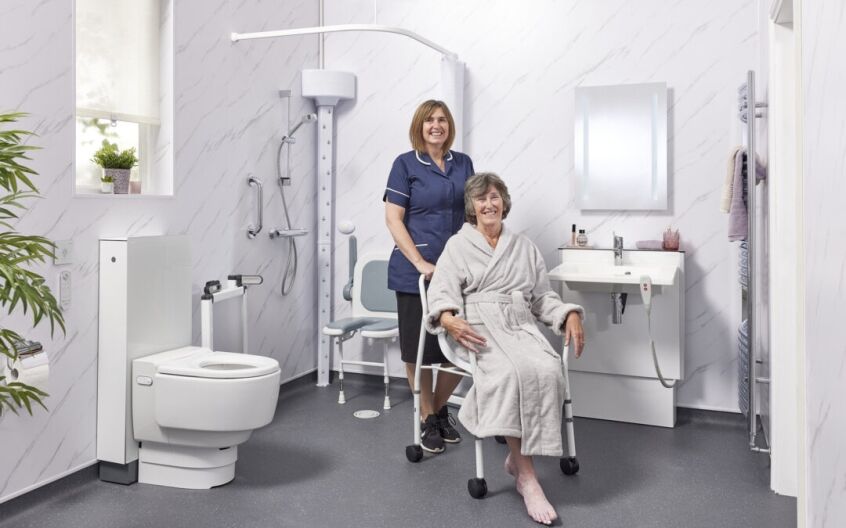
- If you need a carer to help you wash, standard cubicles are tight and awkward. Carers often get soaked reaching over doors.
- The Benefit: In an open wet room, a carer can stand comfortably alongside you. Half-height “Carer Screens” keep them dry while allowing them to assist you safely.
3. Condition-Specific Relief (Arthritis & Dementia)
Different conditions require different bathrooms.
- For Arthritis: No stepping high means less hip/knee pain. Plus, Underfloor Heating helps soothe stiff joints in the morning.
- For Dementia: High-contrast designs (e.g., blue floor, white walls) reduce visual confusion and prevent falls.
- For progressive conditions: Where needs will change over time, a wet room avoids a second renovation later. See our dedicated guides to bathroom adaptations for MS and bathroom adaptations for Parkinson’s.
4. Lower Water Bills (The Eco Angle)
- The Maths: A bath uses 80 litres. A 5-minute shower uses approx 35–45 litres.
- The Benefit: Switching to a wet room cuts hot water usage by ~50%. For pensioners on fixed incomes in 2026, this is a significant monthly saving.
5. Superior Hygiene (Anti-Microbial)
- The Benefit: No corners, no silicone seals to rot, and no door runners to scrub.
- Pro Tip: We use modern grout and vinyls with Anti-Microbial technology that actively stops mould and bacteria growth, keeping the room sterile with less scrubbing. (Read our Cleaning Guide).
Every wet room we fit is designed around the person using it, not a template.
Thinking about a safer bathroom?
Book a free, no-obligation home visit. We assess the room, check whether you qualify for 0% VAT, and leave you a fixed-price quote to think about in your own time.
 Book a Free Home Assessment
Which? Trusted Trader · Lifetime installation guarantee · 0% VAT if you qualify
Part 3: The Drawbacks (The Cons) & Solutions
Con 1: “Wet Rooms are Cold”
- The Reality: Removing a radiator can make a room feel chilly.
- The Fix: We install Thermal Insulation Boards (like Wedi) under the tiles to reflect heat back up. Combined with underfloor heating, the floor acts as a giant radiator.
Con 2: “Water Goes Everywhere”
- The Reality: Without a door, water can splash.
- The Fix: Smart Zoning. We use fixed glass panels or “Spray Guards” to create a dry zone for your toilet roll and towels.
Con 3: “It’s Too Expensive”
- The Reality: It involves structural tanking, so it costs more than a tray swap. (See our wet room cost guide).
- The Fix: If you have a disability, you are eligible for VAT Exemption (saving 20%) on one of our wet rooms for the disabled. (Check your Eligibility here). You may also qualify for a VAT-free installation and a Disabled Facilities Grant, and Attendance Allowance can be put towards bathing adaptations.
Part 4: The Safety Checklist (OT Approved)
If you are designing a wet room for safety, ensure your installer includes these 5 features:
- R-Rated Flooring: Ensure the vinyl or tile is rated R11 or R12 for slip resistance (the higher the number, the better the grip).
- Thermostatic “Cool Touch” Valves: These ensure the metal shower bar never gets hot, preventing scalds if you grab it for support during a fall.
- Grab Rail Positioning: Don’t guess. Rails should be placed at the specific height of the user’s wrist/elbow. An OT Assessment can define this for you.
- Tempered Safety Glass: Any shower screen must be reinforced safety glass that shatters into blunt cubes, not dangerous shards.
- Emergency Unlock: If the bathroom door opens inwards, swap it for a sliding door or one that opens outwards, so a fall doesn’t block entry for emergency services.
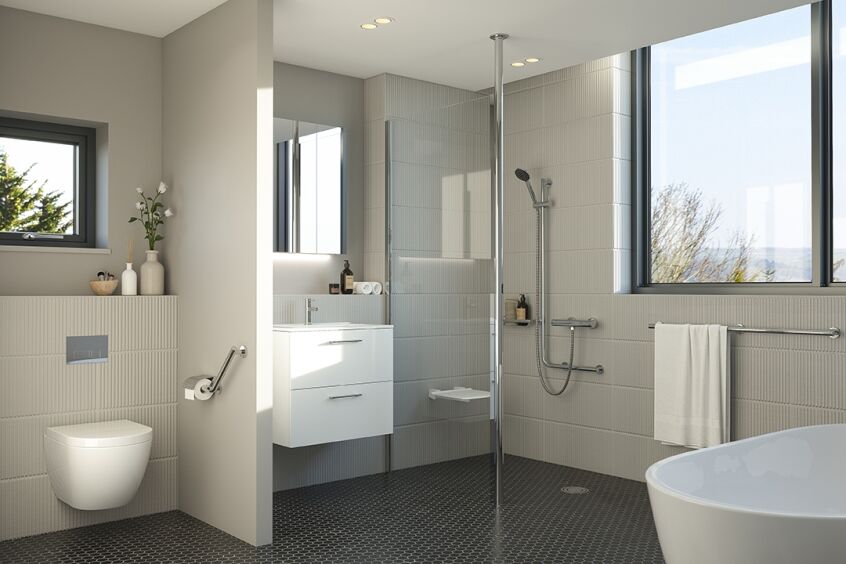
All five safety features come as standard in our level-access wet room installations.
Comparison: Wet Room vs. Walk-In Shower
| Feature | Wet Room (The Specialist Choice) | Walk-In Shower (The Quick Fix) |
|---|---|---|
| Floor Level | Completely flat (0mm step) | Low step (40mm–100mm) |
| Waterproofing | Fully tanked room | Sealed tray only |
| Wheelchair Access | Excellent (full turning circle) | Difficult (lip gets in the way) |
| Assisted Bathing | Excellent for carers | Restricted |
| Future-Proofing | Suits walking frames, hoists and wheelchairs without further work | May need replacing if mobility declines |
| Installation Time | 3–5 days | 2–3 days |
| VAT Relief | 0% VAT for eligible customers | 0% VAT for eligible customers |
Still weighing it up? Read our full wet room vs walk-in shower vs bath comparison.
Frequently Asked Questions
Q: Do I need an Occupational Therapist (OT) Assessment?
A: If you are applying for a Council Grant (DFG), yes—the council will send an OT. If you are paying privately with EA Mobility, our experienced surveyors perform a similar assessment of your needs during the home visit, speeding up the process.
Q: Can I install one upstairs?
A: Yes. 60% of our installations are upstairs. We use structural formers to ensure they never leak. (Read our Upstairs Guide).
Q: Will it devalue my home?
A: In 2026, a luxury accessible wet room adds value as a “future-proof” feature. A clinical plastic one will devalue it. Style matters.
Q: Are wet rooms good for the elderly?
A: Yes. For older people, the step-free floor removes the single biggest bathroom fall risk—climbing over a bath side or shower tray. Combined with a fold-down seat, thermostatic controls and well-placed grab rails, a wet room lets most people shower independently for longer, and gives a carer room to help when needed.
Q: What are the disadvantages of a wet room?
A: The three most common complaints are a cold floor, water spreading across the room, and a higher upfront cost than a tray-based shower. All three are design problems rather than inherent flaws: insulation boards and underfloor heating solve the first, fixed glass panels solve the second, and VAT relief and grants offset the third.
Q: Is a wet room safer than a walk-in shower?
A: For anyone using a wheelchair, walking frame or carer, yes. A walk-in shower tray still has a 40–100mm lip to step over, which is exactly where trips happen. A wet room has none. For someone who is steady on their feet and wants a quicker, cheaper job, a low-level walk-in shower can be perfectly safe.
Q: How long does a wet room last?
A: A professionally tanked wet room should last 15–20 years or more. The waterproofing membrane is the critical element; if it is installed correctly the room will outlast the fixtures fitted in it. EA Mobility installations are covered by our Lifetime Installation Guarantee.
Summary: Is it worth it?
If you value safety, independence, and future-proofing, a wet room is the best investment you can make. It isn’t just a bathroom; it’s the ability to stay in your own home for longer.
Still undecided?
We can bring the showroom to you.
Let us show you how we can add value to your home and your daily life.
This guide offers general information on home adaptations and is not medical advice. For advice tailored to your condition, speak to your GP or an occupational therapist.
Sources & Further Reading
- GOV.UK – Disabled Facilities Grants: eligibility and maximum award amounts.
- HMRC VAT Notice 701/7 – Reliefs from VAT for disabled and older people: the rules behind the 20% VAT saving.
- Approved Document M – Access to and use of buildings: accessible bathroom dimensions and fixture heights.
- HSE – Slips and trips: background on slip-resistance ratings for wet floors.
- Waterwise: UK guidance on bath and shower water consumption.
- EA Mobility & the MS Society and EA Mobility & Parkinson’s UK: our charity partnerships.

Denleigh Carvell
Project Manager at EA Mobility
Denleigh oversees projects across the UK—from walk-in baths and low-level showers to wet rooms—making homes safer and more accessible.